

Biography
Lara Dopazo Ruibal studied journalism at the University of Santiago de Compostela and holds two masters, one in International Cooperation and another in Theoretical and Practical Philosophy. Her first work, From Fish Island, formed the basis of a short film, Stone Island, directed by Adriana Páramo. Other publications include Sheep (2016), winner of the Francisco Añón Poetry Prize, Clementine (2016), Wolves in the House of Esau (2017), and Claus and the Scorpion (2018), a collection that explores healing and violence and winner of the Fiz Vergara Vilariño Poetry Prize. An English translation by Laura Cesarco Eglin is available from co·im·press and was longlisted for the 2023 PEN America Award for Poetry in Translation. She has since published two fiction books: The Axolotl and Other Stories of Beasts and Water (2020), winner of the Illa Nova Award for authors under the age of 35, and Yankee Tales (2024), based on her experience of living in Iowa between 2021 and 2023, which received the Galician Critics’ Award.
Synopsis
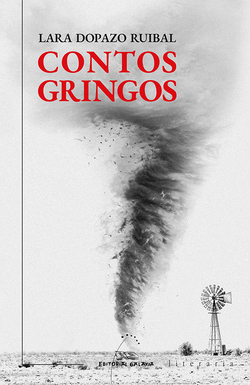
Yankee Tales (118 pages) is a collection of thirteen short stories based on the author’s experience of living in Iowa between 2021 and 2023 while attending the University of Iowa’s MFA programme in creative writing. According to the blurb of the Galician edition published by Galaxia, the book contains tornadoes, cornfields, wild animals, reptilians, unexpected deaths, and a lot of cold. Reality and the supernatural merge until becoming indistinguishable. In the first story, “The Red Block House”, two women, Mia and the narrator, arrive from the same country and rent a house together. Mia occupies the ground floor (number 12), and the narrator lives upstairs (number 12½). Because they look alike, people joke that they are the same person.
Sample
As chance would have it, we not only moved to the same house, but arrived on the same plane. In fact, it wasn’t one plane, but two. First, a long, transoceanic journey. Then, a domestic flight on a little plane that looked like a toy.
We made each other’s acquaintance right there, in the airport we were departing from. The same formalities, the same visa. We arrived after about a thousand hours with our enormous suitcases, once night had fallen, and the city struck us as small and charming. Our new home was a wooden house that seemed to have come out of a sixties movie. Old, blanched, with a front and back porch and earth disturbed by a family of squirrels that hid their booty by the door to the basement.
We found out about the squirrels later. That first night, we simply arrived, retrieved the key from the place where the landlord had left it, a little hidden from the eyes of passers-by, and took possession of our respective abodes. She, Mia, would live in number 12, while I would be in number 12½, which meant she would go in through the main door, while I would use the side door; she would occupy the ground floor, while I would be upstairs.
Living in half a house struck me as both exotic and unsettling, but most of all it seemed to be an accurate reflection of reality. The basement and garden were shared, and the rest of the house was divided into two identical, independent dwellings. Apart from sharing a house and nationality, we would share our work and also, soon, a circle of acquaintances and friends. We had no choice but to get on well, or at least to try to do so.

 Portico of Galician Literature