
Synopsis
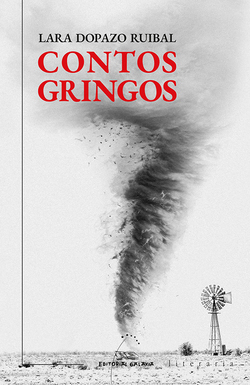
Yankee Tales (118 pages) is a collection of thirteen short stories based on the author’s experience of living in Iowa between 2021 and 2023 while attending the University of Iowa’s MFA programme in creative writing. According to the blurb of the Galician edition published by Galaxia, the book contains tornadoes, cornfields, wild animals, reptilians, unexpected deaths, and a lot of cold. Reality and the supernatural merge until becoming indistinguishable.
In the first story, “The Red Block House”, two women, Mia and the narrator, arrive from the same country and rent a house together. Mia occupies the ground floor (number 12), and the narrator lives upstairs (number 12½). Because they look alike, people joke that they are the same person. Opposite them lives a couple in their late fifties, Tim and Kate, who are always working on their house, fixing the door to the basement, painting the fence. What is strange, however, is that they never see them together. They wonder if they’re the same person. Summer gives way to winter, when a van parks in the women’s garden and the driver takes some tools to Tim and Kate’s house. Then there is a lorry with some materials, followed by two vans with builders who have come to repair Tim and Kate’s roof. The narrator is incensed that their property should be invaded in this way and talks to Kate, who knows nothing about it, but says she will not let it happen again. When the same two vans again park in the garden, the narrator threatens to call the police. At this point, dog shit begins to appear in their garden. The narrator retaliates with a dead raccoon. Tim shovels dirty snow in front of their house; the narrator takes revenge by vandalizing their immaculate fence. When a pile of dog shit appears on their front door mat, the narrator crosses the road and hits Tim on the head with one of the red blocks the house is made from. When she returns from her run, she finds out there are two bodies – Tim is dead on the porch, and Kate is dead in bed, both with the same head wound. Not only that, but Mia has been arrested after they found red dust on her hands and pyjamas. The narrator escapes the country. She is just afraid that Mia will receive a death sentence and she will die as well.
In the second story, “Reptilian” , two women and two men are visiting an old mill in a nature park on one side of the Mississippi. A woman is explaining the history of the mill – one woman tries to listen, while the other tries to remember the spelling of “Mississippi”. The men have gone upstairs. Three quarters of an hour before, they have taken mushrooms, as a result of which the trees have started floating, the colours have changed, and the sounds have become more intense. Zay’s pupils are so dilated that she is wearing sunglasses to hide them. The woman in the mill asks if she is from Argentina, where, she says, lots of Nazis are living, the cause of all the wars and conflicts. She calls them illuminati or reptilians, and cites lots of famous people who are in fact reptilian, not human. Upstairs, the men find a score of bats between a window and its shutter. They call to the women, and all of them observe the bats enthusiastically. They then ask if they can swim in a nearby river. The woman says it’s a free country and is shocked when Zay takes off her sunglasses to reveal her pupils.
In the third story, “Eleven and a Half Hours”, a man has ridden his bike into a tree and hurt his knees. One knee is bleeding rather badly. He goes to emergency, where he is seen briefly by a nurse (who doesn’t think it’s bleeding that badly) and then made to wait. The man amuses himself by watching the other people in the waiting room – a woman who appears to suffer from dementia and keeps escaping from her wheelchair; an elderly man in white pyjamas, with large feet; a family with two little girls; a young woman in a torn raincoat whose feet smell of dampness; two young men, one of whom has a strong pain in his penis and is afraid he has contracted an STD; a prisoner in an orange jumpsuit being pushed by a policeman while chained to his wheelchair; a couple of musicians. The waiting room is freezing. A TV is playing at full volume – first a programme about home repairs, then about river fishing, and finally about organizing weddings. In the middle of the waiting room is an aquarium. The man is eventually seen by a junior doctor, who goes to consult his superior. He is taken to have his legs X-rayed. A nurse then cleans his wounds with a nailbrush, which is painful, but effective. When he is told he can leave, he notices that the waiting room has become very still, the aquarium is empty, and the floor is flooded. People have changed positions – the demented woman’s son is now in the wheelchair; the two little girls are asleep on the laps of the musicians, their parents are nowhere to be seen; the young men are naked from the waist down, comparing penises; the policeman is now chained to the wheelchair, while the prisoner leans against the exit, smoking a cigarette. It has taken the man eleven and a half hours to be seen.
In the fourth story, “Mist”, after a summer of high temperatures and drought, a thick mist descends upon the coast. People are advised to be careful and to stay at home if at all possible, but one woman takes to walking in the mist, sharpening her other senses. She walks down to the sea, where she hears the sound of bodies falling in the water. Then she hears the slight murmur of what could be an engine – that is, someone who is dropping the bodies in the water. She then climbs up to the cliff, where she crawls along on all fours and sees a tenuous light. Her husband thinks the mist has driven her crazy and is exasperated when she returns home late and dirty. Eventually the mist disappears. The woman consults experts, fishermen, to find out if they know anything about such a mist. She goes to see an old woman who can predict the weather and who tells her not to try to understand everything. She receives a feeling of peace from this visit and starts to forget about the mist, but one morning in winter the dead remains of various animals begin to appear on the beach, and the mist occupies her mind once more.
In the fifth story, “Wild and Unique”, a woman is tremendously envious of a girl she has known since school, Laura, who was perfect, always got good marks, very pretty, with lots of friends. She has everything – the best-looking guy in the school and expensive clothes. She then goes to study Pharmacy at university, which is when the first misfortune occurs. Laura goes on a trip to a tropical country with her boyfriend, who dies from some unknown illness on his return. Laura then marries the son of a hospital director, appears on social media with two glossy labradors and an expensive duplex. It seems she has the perfect life when the second misfortune occurs. She is admitted to a psychiatric hospital while her husband is taken into custody – for profaning dead bodies and taking body parts home to eat. The narrator dreams that Laura visits her in the night, still looking perfect, and eats slices from her body.
In the sixth story, “Soft”, the narrator crosses a cornfield that has been harvested and is very dry, reaches a road, and approaches a group of houses. They have the impression people are watching from behind a row of cars on the other side of the field. They locate what they consider their own house, red on the outside, with two floors. There is a very strong sound, as of a boat docking, and people are hiding in their basements with fearful eyes. A cuddly dog, like a white ball, is cowering under the porch steps when the narrator disintegrates, falls apart, and rises up into the air. The sound ceases; people come out of their houses, crying, shouting, and cursing their luck.
In the seventh story, “Fuchsia”, it is Sunday, and a woman is hoovering her kitchen when she discovers a fuchsia pink sequin in a crack in the floor. She puts it in a box with another one she removed from the shoulder of an air stewardess when returning from a work trip. On Monday, she decides to throw out an orchid which has become dry and plant something else, but discovers a third sequin in the soil. On Tuesday, she teaches a class and discovers another sequin on the floor next to where her favourite student has been sitting. She dreams that night that a deranged mob is chasing her family with burning torches. On the Wednesday, she visits the jacuzzi at her gym, where there is a man with a white Afro haircut she likes, and discovers a further sequin on the edge of the pool. She is reminded of a dress she wore only once three and a half years earlier at a distance of ten thousand kilometres from where she is now, and the terrible thing that happened that night. On Thursday, she finds another sequin on the bus, and on Friday, she is walking through a park with a work colleague when they spot a falcon hunting a little squirrel. The colleague goes to film the scene for her children and finds another sequin at the foot of the tree. On Saturday, she stays at home in the hope that she will be safe there, but at night she notices that the walnut tree in her garden is glinting with lots of sequins. She shakes the branches, then beats them with a stick, climbing into the tree. She then falls and dies of a cardiac arrest. She is discovered with a sequin stuck to one of her pupils.
In the eighth story, “To Serve You Well”, the narrator is a kitchen knife, an object so normal it is almost invisible. Its only purpose is to serve its owner well. Its owner is a woman who organizes a dinner for the man she loves, with good food and wine, followed by liquors, after which they sweep the table clean and make love on top of it. The woman slaps and spanks him and is in such an ecstasy that she grabs the knife, the only object remaining on the table, and the banquet turns into a horror scene. She is given no chance to explain herself. The knife doesn’t judge her – for instruments, there is no good or evil.
In the ninth story, “Brooklyn”, a couple visits New York for ten days. They rent a small apartment, go sightseeing, wade through hordes of tourists to view paintings in the Museum of Modern Art. The woman doesn’t sleep well at night, the neighbour next door and upstairs (she suspects they are the same person) lives at night. One day when they return to their apartment, they cannot find the door and end up opening a room upstairs with a cat inside, old furniture, and an unmade bed. The woman is terrified that they have entered someone else’s apartment and been seen. Then, one night, they are both woken by the slamming of a door, followed by loud bangs on their front door. They get ready to leave, to escape via the patio, but when they wake up, it is to find themselves locked in the room with the cat. She doesn’t know how many years they have been there, a dozen cats have come and gone, it’s difficult to distinguish night from day, depending on the light that filters in through the shutters. She’s just glad that they have each other.
In the tenth story, “Dams”, a woman hears about the death of her aunt, Úrsula. It is the first death that she has had to experience personally. Her aunt spent half her life living in a border town between the US and Canada and had a partner called Chuck. They worked as researchers and conservators in a nature park. The woman had gone to stay with them over successive summers to practise her English. Now she goes to deal with the paperwork and to return her aunt’s ashes to the family home. She spends the morning going through documents and the afternoons going for walks in the local wood, where there are all kinds of animals, including beavers. She is fascinated by the way they slap their tails on the water to warn of impending danger. She starts to find the situation overwhelming and is anxious to leave, but has to wait for the consulate to be ready. Chuck explains that he is going to dismantle the house. He says that beavers do the same when they lose a family member. He will build a new house somewhere else. On her last night, it seems to the woman that the wood has been gnawed away and a puff of wind would blow it away. She loses touch with Chuck, but when her first child is born, Chuck sends her a card in which he says he knows the child will be “one of ours”. It is then the woman notices that the child has the deep, black eyes of a rodent.
In the eleventh story, “Hunting”, the owner of a business thinks that he is going mad. He feels uncomfortable with his life, wants to change it, but doesn’t know how. He used to love hunting. He went with his friends, Jorge and Luis, to hunt during the day and have a good time at night. But the third weekend he went alone, since they were busy, and after shooting some hares noticed that the hunting dogs were frightened, with their tails between their legs. There was also an eerie silence. He decided to return home, but couldn’t find the way back to the car. He then came across a magnificent stag, but didn’t have the energy to kill it. The stag came close to him, and he could see himself, his inner soul, in the stag’s eyes and realized he was not a good man, nor was he leading a good life. He has stopped hunting and has started spending more time with the kids. He doesn’t know what to do and hopes that the person he is talking to, María, can help him.
In the twelfth story, “Brine”, a woman is in the habit of visiting a restaurant where they serve awful hamburgers and pizzas and the owner sharpens pencils in the light of a small window. There are wooden shelves behind the bar with a stuffed raccoon, a miniature fire engine, and some large glass jars with what look like ancient eggs in brine. The woman and her friends visit a dispensary in a neighbouring state, where certain drugs are legal, and return with some gummies, which they proceed to share out at a table in the restaurant where no one can see them. But the next day the owner asks the woman to be more careful. She cannot work out how he could have seen what they were up to. So, she starts hiding things – coins in the seat, bits of paper under the table – only to find that they always disappear, as if they have been detected. The woman suspects there must be some hidden cameras, but cannot locate them. When there is a storm, followed by a power cut, the woman assumes the cameras won’t be working and steals a small magnet off the till, but still the owner notices and asks for it back. It is then she spots an eye, double the normal size, in among the eggs in brine. This is the last time she visits that restaurant.
In the thirteenth story, “Snow”, a woman’s first memory is feeling cold on her eyes and hands, when she was about four. She then took to swimming in the Atlantic, later in rivers. After that, she discovered the Baltic, which was even colder, and travelled north, where she learnt about ice. But in spring the snow would always melt and she would have to endure the heat of summer until the snow came round again. She decided to go and live far north, by the sea, where she would walk barefoot on the snow and her skin grew whiter. In the end, she left her house one day with everything tidy, the heating on, so the pipes wouldn’t burst, the bird feeders full, and simply disappeared without a trace. She had found a way to become snow.
This is a wonderful book of short stories, where, as it says in the Galician blurb, reality and the supernatural merge. It reminded me of a classic of Galician literature, Rafael Dieste’s From the Imp’s Archives, where a sense of the supernatural is also present, and also of Roald Dahl’s Tales of the Unexpected. The stories are expertly written, often in the voice of a woman, sometimes with touches of humour, and always with close attention to detail. It is a book that would work very well in English. It received the Galician Critics’ Prize for literary creation in 2025.
Synopsis © Jonathan Dunne


