

Biography
Cecilia F. Santomé studied French at the University of Santiago de Compostela, and also completed her doctorate on the Belgian playwright Claire Lejeune there. She has worked as a digital content manager in London, as well as co-founding and editing the online magazine Coolt. She is the author of four works of fiction: I Love You, Me Neither (2019), about two people who meet in London and decide to unite their futures; Small Town Girl (2021), about a woman who emigrates to Barcelona and works as a maid; Farewells (2024), about the gap left by the death of a grandparent; and Boundaries Road (2026), about a woman who rents a room in Balham, south London. This last work received the prestigious Blanco Amor Award for novels.
Synopsis
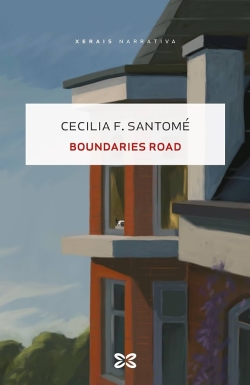
Boundaries Road (272 pages) tells the story of a Galician translator who emigrates to London and rents a room in a house on Boundaries Road in Balham, south London. It covers themes of emptiness and urban alienation. The novel is divided into three parts. In the first, “2015”, Cecilia has been working in London and renting an apartment in zone 2, but she decides this is too expensive and prefers to rent a room in a house in Balham, which is zone 3. She goes to meet Natalie, who will be her landlady, and asks her to cancel her next appointment, since she would like to take the room.
Sample
At the beginning of March, when old people are still hopeful of getting to hear the cuckoo that year and, at daybreak, frost cuts your breath on leaving the house, the wisteria casts off its lethargy to offer the mirage of an early spring. Its mauve racemes – succumbing to their own weight amidst the intense green of the leaves, growing invariably to the left in the northern hemisphere, to the right in the southern – contradict the silken consistency suggested by each flower in its individuality: petals that open in a gesture of unconscious vulnerability to allow the air to slip between them and turn them into accidental kites, daily koinobori flags waving as they cling to their masts, against a façade.
The wisteria explodes like this and spreads a sweetish aroma that irremediably saturates the nostrils and arouses in the palate’s memory the taste of the spoonfuls of honey that were taken in childhood before going to bed, accompanied by exaggerated expressions of distaste.
Planted in the front garden of a modest house in a comfortable outlying district, with its vine’s stem leaning against the frame and a torrent of flowers tumbling over the head of anyone entering or leaving, the wisteria offers a scene of incomparable beauty. A delicate show of welcome without the need for words.
And yet its majestic presence is incapable of distracting the young woman who nervously approaches the entrance and can barely distinguish one species from another, one smell from another, the breeze or the sun beating on her back on this afternoon when, having taken the black line on the Underground in a southerly direction – the one that goes from H. B. station to M. – she covers the considerable physical, aesthetic, social distance that separates the apartment where she lives on a part-time basis and this residential quarter, where she saw a pleasant room for rent at a price she believes to be reasonable.

 Portico of Galician Literature