
Synopsis
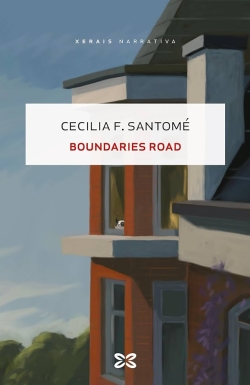
Boundaries Road (272 pages) tells the story of a Galician translator who emigrates to London and rents a room in a house on Boundaries Road in Balham, south London. It covers themes of emptiness and urban alienation.
The novel is divided into three parts. In the first, “2015”, Cecilia has been working in London and renting an apartment in zone 2, but she decides this is too expensive and prefers to rent a room in a house in Balham, which is zone 3. She goes to meet Natalie, who will be her landlady, and asks her to cancel her next appointment, since she would like to take the room. In the next chapter, she is moving her things, using a large and a small suitcase on the Underground, and then trundling along the pavement until she reaches her new address: 62 Boundaries Road. She hopes Natalie will be there to meet her, but this could be one of three days she works in a nearby shop. The third chapter is the description of a painting by a local artist, Ce Efese, which captures the moment a woman arrives at the door of a house, which is opened by a man.
Cecilia translates descriptions of fashion products. Her room doesn’t have a desk, so she has to work on the bed, with a cushion on her knees. There’s no point buying a desk because the rental agreement is only until the autumn. Natalie is preparing some Lebanese food for Tom, her fiancé, who works at the National Gallery. Cecilia tries not to get in the way. Another painting shows a woman passing behind a couple who are happy together. When they are out, she enjoys studying the Polaroids in the sitting room, which show Natalie as a child with her mother. Tom’s presence in the house is much less noticeable, he is an accessory like her and has yet to make an impact. Cecilia has difficulty telling the difference between a b and an m when Natalie speaks, so she is never sure if she is talking about her fiancé – Tom (or Tommy) – or the cat – Tob (or Tobby) – unless of course Tom has yet to arrive home. She and Tom have had little to say to each other. Man, woman and cat form a Trinity in one of Efese’s paintings.
Cecilia is meeting up with some friends in central London. She always finds it difficult to trace a route. While she is getting ready, Tom knocks at her door to engage in small talk and give her his number in case she has an emergency. She finds the conversation awkward. After three months, Cecilia feels she lives in a cabinet of curiosities or a garden of delights. People compare her to women in paintings by Romero de Torres; she likens Natalie to a Rubens. The house has a large collection of books. She gives a jump when Natalie appears behind her and invites her to borrow any of them. She likens her fright to that she felt when her parents left her as a child. In the hallway, she suffers from the same syndrome as Stendhal when he visited Florence’s Basilica of Santa Croce – an overexposure to beauty that leads to a quickened pulse. Marriage and death are linked in Efese’s next painting, which shows a pile of books, a wedding invitation and a dead beetle.
Cecilia entertains her friends by telling them stories about Tom and Natalie and how in love they are, like a soap opera. She wonders if deep down she isn’t actually envious of the happiness and stability they enjoy. But she is disturbed by an event the previous evening, when Tom came into the kitchen to talk to her and Natalie showed signs of being jealous. Cecilia continues to borrow books, but has difficulty finding one she was interested in, on Henry VIII. This leads her to discover a picture of motherhood by Picasso behind a pile of books on the stairs. Natalie is in a nervous state, worse than when her father died or she left her previous boyfriend, and can’t stop pacing up and down from the front door to the back garden. She herself has made an awful discovery. She is worried that she will end up like Miss Havisham in Dickens’s novel Great Expectations, who was jilted at the altar and lived the rest of her life as a recluse. Her and Tom’s wedding is only four months away. She bumps into Cecilia in the street. She is taking Tobby to the vet, but carrying him in her arms. She seems to have forgotten she has the pet carrier. Back in the house, Cecilia is afraid of being alone, without Tom and Natalie, and wonders whether the picture by Picasso is an original or a copy.
Tom is staying with an ex-colleague (hardly a friend) called Eustache in a different part of London. He is sleeping on the sofa and feels very uncomfortable with the mess there is and a strange, shell-like object he can make out on the ceiling. He admits to himself that he has made mistakes and would like to justify himself before Natalie by using a literary work – by Edith Wharton, perhaps – that shows how, despite obstacles, love will find a way. Cecilia tries to work out from what Natalie is saying what the problem is, but isn’t sure whether she is talking about the cat, Tob, or her fiancé, Tom. It seems Tobby is suffering from a life-threatening illness and Tom has done something not nice, for which Natalie would like to teach him a lesson. Four days have gone by, and all Natalie feels for Tom is repugnance. She cannot bear the idea of having him close. Cecilia feels caught in the middle. She imagines her parents getting divorced. She feels like Maisie in Henry James’s novel What Maisie Knew, a daughter who is used by each of the parents to torment the other. Natalie announces that she and Tom are breaking up. Meanwhile Tobby has died and is buried in the garden.
Natalie’s mother, Fleur, comes to stay. While her daughter is having emotional difficulties, Fleur uses Cecilia as a substitute – everything goes well, so long as Cecilia doesn’t proffer an opinion – and tells her about the difficulties she’s having with her Turkish builders or about growing apples. She is very critical of Cecilia’s accent. Tom receives an ultimatum from Eustache: he must vacate the sofa before the weekend. Tom feels he has confused the brake and the accelerator, and his only option is to accelerate as hard as possible, which ends with him in hospital on a breathing machine. Cecilia feels overwhelmed and would like not to know so many details from Natalie and Fleur about the disasters that are occurring in their lives. Meanwhile Natalie resists the urge to rip the page for October from the calendar, since this is when she was due to be married. At the end of this part of the book, Cecilia leaves the house with another destination. She hasn’t let Natalie know. She leaves the front-door key on the kitchen table, with a note saying “Thanks for everything”, though in reality the last few months have been a calvary and the house where she has been staying hasn’t felt like her own.
In part two, “2022”, it is seven years later. The radio announces two deaths: Terry Hall, lead singer of the Specials, and Maya Widmaier-Picasso, eldest daughter of the painter Pablo Picasso. There follows an obituary of Maya, who was her father’s greatest muse for more than a decade and inspired a series of portraits. A woman caresses the cover of a notebook with three names on it: “Madonna – Picasso – Balham.” While watching a boy consume five biscuits with supreme delight, she recalls a certain spring and a picture she found. She cannot remember the picture in detail, but insists on restoring it in her memory. She makes a list of things to do: “Description of the work – Dating – Attribution and authentication.” This will be, for her, a new kind of speculative fiction. Step one is to describe it. A woman is sitting on a chair, holding a baby on her left leg. Her hair is loose and falls down her back. The baby is laughing without separating its lips, and its cheeks are plump as peaches in August. She has difficulty pinpointing which Mother and Child by Picasso this could be, since there are so many of them. She finds information about an exhibition on Picasso and maternity in Le Puy-en-Velay and watches a presentation by Picasso’s granddaughter, Diana Widmaier, and Emilia Philippot on the steps of the Musée National Picasso-Paris.
Step two is to date it. Again, she cannot be precise. She doesn’t have Christian Zervos’s thirty-three-volume catalogue of Picasso’s works to hand, so she can’t go through all of his paintings. She can only date it approximately by reading about Picasso’s periods and seeing which features are in the picture. She retrieves her notes from studying History of Art at school from the attic and focuses on Picasso’s more optimistic Rose Period, characterized by pleasant themes and hues of red, orange and pink. The woman is drawn to a painting from 1905, Lady with a Fan, and thinks this might have something in common with the picture she has provisionally given the title Mother and Child.
Step three is to attribute and authenticate the picture. Since the death of Maya, Picasso’s second son, Claude, has been the main person who authenticates his father’s paintings. The woman discovers an online catalogue, “On-line Picasso Project”, which is administered by Enrique Mallen, and trawls through 2,000 pictures relating to the period that interests her, the Rose Period, paying particular attention to those that show a mother and child. She is hoping to find a representation of the very picture she discovered in Natalie’s house, but is disappointed. The woman translates part of an article on the Stendhal Syndrome, which affects mostly people who live alone and have had a classical or a religious education. She thinks perhaps the picture may belong to a private collection, and that is why it hasn’t been catalogued. She reaches out to various experts and museums dedicated exclusively to Picasso’s art, but doesn’t receive any satisfactory answers. She goes back to the idea that the picture formed part of a private collection – that of Roland Castro, a Jew from Egypt, who died in 2006 and was survived by his second wife, Fleur, from whom he was divorced, and two children, including a daughter named Natalie. It would seem the Picasso she came across on the stairs of Natalie’s house was genuine.
Part three takes the form of a novel by Cecilia Fernández: Mango Tree. The first chapter recreates the expulsion of Jews from Egypt between 1956 and 1957, following the outbreak of the Suez Crisis. We then come across Roland Castro, the Jewish collector, who now lives in London and is savouring the first mangos of the season. He feels emotional – the taste reminds him of his native Egypt, where the mango was officially introduced in 1838. It wouldn’t reach England for another hundred years, in 1931, when the seaplane made it possible to import them. When Roland Castro bought a single-family house in an exclusive housing development to the south of London, he immediately made himself unpopular with his neighbours by planting a mini-forest in one corner – brambles, ferns, thickets – and by raising chickens, something his first wife couldn’t stand. He felt it was important for the children to grow up in contact with nature. He lived events in Egypt from a distance, but the photos he has are precious to him. He keeps them in a cigar box that belonged to his father. He found his first wife too stiff, lacking in humour. Whereas he wanted children who were spontaneous, inclined to blow bubbles in their milk or to lick their plate, she wanted children who were well behaved, exemplary. When he played the piano for two hours every morning before going to work, she would place a pillow over her head to make clear her disapproval. When mangos came into season, he would take the children upstairs and feed them slices in the bathtub. She preferred to buy the children a cocker spaniel, which she hoped would make the neighbours like them again. Sitting in the garden, he begins to feel unwell. He is assailed by multiple memories, a veritable carousel, and goes to lie down for a bit, even though it’s mid-afternoon. Death finds him lying on his bed, with his shoes still on, the wind gently stirring the curtain. There follows the Mourner’s Kaddish.
Boundaries Road is an ambitious novel. The author herself defines it as a kind of Russian stacking doll in a note at the end. The name of the street in Balham reflects the boundaries that exist between cultures and how a person can feel alone in a culture that is not their own, in a house that belongs to others. It seems that if we do not belong to the inner circle, then we are guests, or strangers, in someone else’s surroundings. Cecilia (the same first name as the author) never feels at ease. Her experience is mirrored by the short descriptions of paintings carried out by a local artist, Ce Efese (which is another incarnation of the author – “Ce” is the first syllable of “Cecilia”, and F and S are the initials of her two surnames). In the second part, it is the author who investigates the possible existence of a Picasso original in the house in London, and in the third part, who recreates the final days of the Egyptian collector Roland Castro in her novel Mango Tree. So, the author takes on myriad roles, presents herself in the book under different guises. It is a novel about identity and exile, emigration and homecoming, and the boundaries that separate us as individuals, which we spend our lives trying to cross or at least to comprehend. An intelligent novel that deservedly won the Blanco Amor Award in 2025.
Synopsis © Jonathan Dunne


