
Synopsis
Domingo Villar is famous in Galicia for his series of crime novels featuring the dyed-in-the-wool Galician detective Leo Caldas and his Aragonese sidekick Rafael Estévez. He published three novels in total: Water-Blue Eyes (2006), Death on a Galician Shore (2009) and The Last Boat (2019). The first two have appeared in English.
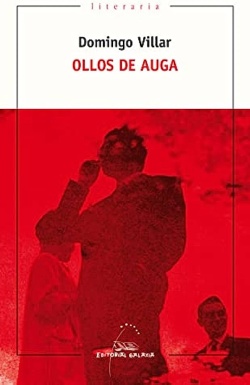
Water-Blue Eyes (248 pages) is the first novel in the series, in which we are introduced to the character of Inspector Leo Caldas and his assistant, Rafael Estévez. It comprises twenty-nine chapters. As well as being a police officer, Inspector Leo Caldas features on a radio show, Patrol on the Air, which gets some pretty strange phone-ins and general complaints (a noisy pub below where the person lives, green lights not staying green long enough for the old man to have time to cross the road). All these complaints Caldas plans to forward to the city police, they’re not his responsibility.
His sidekick, Rafael Estévez, has recently been transferred from Zaragoza to Vigo and is finding it difficult to cope with the unpredictable weather, the steep streets and a certain ambiguity in the way Galicians express themselves. Caldas and Estévez are called to an address in a high-rise on Toralla Island, a small islet to the south of Vigo. In the bedroom of the apartment, they come across the dead body of a man. He is naked and his hands are tied to the headboard. It is obvious he has died in a good deal of pain. The man is Luis Reigosa, thirty-four years old, a professional saxophonist. Caldas is not bothered by dead bodies, he treats them like lost property. But once he knows a few biographical details about the person in question, these send a shiver down his spine. It is as if they have become real again.
The body had been discovered by the cleaner. The man had been killed the previous evening. His genitals look black, as if they had been burned, but there’s no sign of fire. And he has remarkable, water-blue eyes. His bookshelves are packed with crime novels. The forensic doctor concludes that Reigosa must have known his murderer, since they had gone to the bedroom to have intercourse. Caldas wonders how that was possible, given how small his penis is. The bathroom looks very luxurious for a jazz-club musician to have been able to afford. In the living room, Caldas comes across hundreds of CDs and scores of music. Because of the art on the walls, Estévez deduces that the saxophonist must have been gay, but Caldas has noticed lipstick on one of the glasses he and his companion had been drinking from.
Caldas visits a bar, ‘Eligio’, which was once frequented by famous Galician artists and intellectuals. Back at the police station, Caldas and Estévez question the cleaner, María de Castro Raposo, a woman of sixty-four, albeit a youthful sixty-four, as she declares. Estévez is frustrated by the way the woman doesn’t come out with clear statements, but always seems to qualify them – the ambiguity in Galicians’ speech he finds difficult to accept. Caldas takes over the questioning. He informs María that the police found her fingerprints all over the apartment, including on the glasses Reigosa and his companion had been drinking from. María claims she needed a drink in order to get over the shock of discovering Reigosa’s dead body. Caldas informs her that this has messed up their only lead, her fingerprints have obliterated the others. The only other print they found, apart from Reigosa’s and the cleaning lady’s, was a small fragment on the bottom of one of the glasses, but it’s not complete and so can’t be fed into the computerized archive to see if there’s a match.
The forensic doctor explains that someone injected formaldehyde into Reigosa’s genitals. This caused all the tissues to dry up, which would explain his shrivelled appearance. The injection would have caused Reigosa a lot of pain, especially in an area of his body that has such a large blood flow. Formaldehyde is pretty easy to come by in a hospital. It also has industrial uses. But the doctor agrees that the murderer has to be someone with specialist knowledge, not a general hospital worker. Formaldehyde can be obtained from different labs, but the one the doctor uses is Riofarma, a lab near Vigo. The doctor backs up Estévez’s belief that the saxophonist was gay.
The policemen pay a visit to the laboratory Riofarma in the village of Porriño, some ten kilometres from Vigo. They are met by Ramón Ríos, an old schoolmate of Caldas’s, whose family owns the lab. Caldas asks for a list of clients from Vigo who order formaldehyde. They are told to talk to Isidro Freire, who is in charge of sales of their products in Vigo. Caldas and Estévez eat sardines at a restaurant in Porriño. Caldas is due to see his father the next day. His father makes white wine and is reluctant to leave his vines to visit the city. They then attend Reigosa’s funeral in Bueu. There are about forty people, including Reigosa’s mother, some fellow jazz players and children he taught at the Vigo conservatory. There is also a man with a shock of white hair. Caldas arranges to speak to Reigosa’s band mates, an Irishman, Arthur O’Neal, and Iria Ledo, later that night, at a concert they’re giving in memory of the saxophonist.
Caldas and Estévez visit a beach from Caldas’s childhood, where Estévez gets stung by a weever fish. Caldas is having problems with his partner, Alba, over the question of having children. In the evening, Caldas visits the jazz bar in Vigo, the Grial, where the concert is due to take place. Iria confirms that Reigosa was gay and sometimes visited a gay bar, the Idílico, after concerts. Caldas learns that Reigosa was friends with the DJ there, Orestes. Orestes confirms that Reigosa had various lovers, but, when Caldas asks about a man with white hair, he has the impression Orestes is hiding something or is afraid. They arrange to talk the next day, when it’s not so noisy. Meanwhile, Caldas visits the General Hospital, where a doctor confirms formaldehyde can be used by anyone. Caldas asks if there are any male doctors. There is one, Dr Alonso, who is married and has kids, but he was away at a conference at the time of Reigosa’s murder. Caldas decides to focus on pathology departments.
They visit the Zuriaga Foundation, a maternity clinic that has other specialities. Caldas asks for a list of staff with access to operating theatres and comes across the portait of a man with white hair and a prominent nose, Gonzalo Zuriaga. The hospital is currently managed by this man’s nephew, Dimas Zuriaga, who also has white hair. They go to visit him at home since he apparently hasn’t been well the last two days. When Caldas shows him Reigosa’s photo, Zuriaga claims not to know him, so Caldas pretends they have a witness who’s prepared to testify that the two of them knew each other. He also asks him if he was at a funeral the day before. They are sent packing by the doctor, who threatens legal action.
Caldas meets up with his father, who is disappointed the restaurant doesn’t have bottles of his wine. Caldas speaks to Ramón Ríos from the laboratory Riofarma to confirm a delivery of his father’s wine. Ríos says Isidro Freire has gone missing. After lunch with his father, Caldas goes to meet Orestes, the DJ from the Idílico, but the DJ doesn’t turn up. Caldas is afraid he’ll be hounded by his superior for having harrassed Zuriaga at home. While taking part in his radio programme, Patrol on the Air, Estévez arrives to inform Caldas that the DJ is dead. They search the DJ’s apartment and find incriminating photos of Luis Reigosa with Dimas Zuriaga on his computer. Caldas confronts Zuriaga at home again. Zuriaga admits he was in a relationship with Reigosa and claims someone was blackmailing him with the photos. His wife, Mercedes, didn’t know about his relationship and he preferred to keep it that way in order to protect the Foundation and his marriage.
They take Zuriaga to the police station. Caldas suspects Zuriaga found out the people behind the blackmail were Orestes and Reigosa and planned to kill Reigosa in the most painful way possible, by injecting him with formaldehyde, but he made a mistake and left some fingerprints on the glasses. They still have a fragment of one of those fingerprints and, if it matches Zuriaga’s, they will have placed him at the scene of the crime. Caldas also suspects Zuriaga of having later shot Orestes, Reigosa’s accomplice. His superior, Superintendent Soto, says they need evidence to prove this theory. A latex glove was abandoned near Orestes’s apartment, which may contain Zuriaga’s DNA, and Caldas suspects the sales rep, Isidro Freire, who supplied the Zuriaga Foundation, will also turn up dead.
The print in Reigosa’s flat doesn’t match Zuriaga’s, but his DNA is found inside the latex glove. Zuriaga is deflated, the papers pronounce him guilty, but his niece, Diana, who works at the Foundation, speaks up in his defence. Over lunch, Caldas is suspicious because in Reigosa’s apartment they found two books by the bedside, one a crime novel, the other Hegel’s Lectures on the Philosophy of History, which don’t seem to go very well together. Hegel wrote a defence of the Inquisition and welcomed pain if it was a cause for repentance. Caldas then remembers a caller who phoned the radio programme and repeated the phrase, ‘Let us welcome pain if it is cause for repentance.’ Caldas discovers the caller was ringing from the Zuriaga Foundation on the day after Reigosa was murdered. This is too much of a coincidence.
Caldas discovers the phrase, ‘Let us welcome pain if it is cause for repentance,’ is from the book by Hegel and now suspects Isidro Freire of involvement in Reigosa’s murder. He believes Hegel’s book by the bedside and the quote on the radio were done deliberately to incriminate Zuriaga. Caldas and Estévez visit Zuriaga’s wife, Mercedes, to see if Freire had been in contact with the doctor. Mercedes claims not to know anyone by that name, but as they are leaving, Freire’s dog appears. Mercedes then admits that Freire is on their boat, terrified. She had found out about Zuriaga’s relationship with Reigosa and had started a relationship herself with Freire. She followed Zuriaga when he was leaving money because of the incriminating photos and discovered the blackmailer was Orestes. She was afraid if news about the relationship came out, her husband would be forced to abandon her, so she planned and carried out Reigosa’s murder with Freire as her accomplice and left Hegel’s book by the bedside. Freire then placed the call to Caldas’s radio programme. Mercedes’s plan was that Caldas would arrest Zuriaga and she would be able to enjoy the family’s fortune. She was only afraid that Orestes might compromise her in some way, so she murdered him as well, leaving a latex glove with her husband’s DNA as bait for the police.
Water-Blue Eyes is a very well written and absorbing story. The narrative has enough threads to make it convincing. There is also an intriguing plot twist, where suspicion passes from Zuriaga to Zuriaga’s wife. Caldas is more quiet and reflective, Estévez, his sidekick, is more aggressive, and together they make a good team. It is no surprise that Domingo Villar is considered one of Galicia’s most international writers.
Synopsis © Jonathan Dunne

 Portico of Galician Literature