
Synopsis
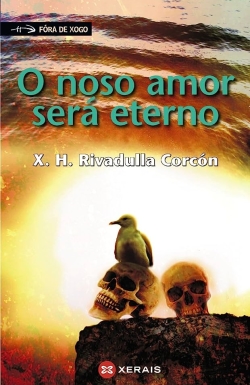
Our Love Will Be Eternal (208 pages) is one of several books of young people’s literature written by X. H. Rivadulla Corcón. This title is aimed at teenagers and won him the Martín Sarmiento Award, an award voted on by schoolchildren, in 2013. It tells the story of the love between a troubadour, Buserán, and a beautiful girl, Frolinda.
The book is divided into thirty-five short chapters. Buserán has been imprisoned. Albeit at risk to himself, the jailer allows Frolinda a brief visit, during which the two young lovers swear eternal love to each other. Eight centuries later, two lovers are lying on the grass above a sea grotto. The cave is located on the famous Coast of Death in north-west Galicia, to the west of the town of Muxía. The man, Ramón, tells his lover, Rocío, the legend of Buserán and Frolinda. Buserán was a medieval troubadour who had visited the local count’s castle and fallen in love with his daughter. The count could not accept their love and ordered that Buserán be thrown off the cliff. His soul now inhabits the cave, which is known as Buserana Cave, and is said by local fishermen to sing ballads in the wind. Frolinda, visiting the cliff, was swept up by a wave. It is Ramón’s birthday, and Rocío gives him a book he has been after, The Book of Saint Cyprian: The Sorcerer’s Treasure. She then goes to feed the seagulls the remains of their picnic and slips off the cliff, falling to her death. Ramón is distraught.
Ramón remembers how he first met Rocío, a schoolteacher who came to teach in Muxía. Rocío is buried in the town to the sound of the fishing boats’ sirens. In the next chapter, thirty-five years have gone by, and Ramón is now an old fisherman. All he has done during this time is put out to sea, share his life with friends and continue loving Rocío with the same intensity. While the fish are being auctioned, he is approached by a young girl, Lola, his best friend’s granddaughter, who asks if he has finished the kite he was making for her. They go to fly the kite; a passing seagull envies the kite its colours, but is glad it can go where it likes and is not tied to humans.
Ramón chats to another fisherman, Eduardo the Rat, who runs the local tavern. They wonder whether it is possible for them ever to retire, to leave the sea behind. A young sailor presents Ramón with a sea snail; he can add the shell to his collection of objects rescued from the sea. Fishing near Buserana Cave, Ramón discovers a human skull, which he also adds to his collection. A strange-looking couple appears in the empty streets. They are the age Buserán and Frolinda were when they died. They are looking for someone to help them. A seagull alights on Buserán’s shoulder.
The young man greets Ramón as he sets out for a day’s fishing and says he would like to talk to him on his return. Ramón is struck by the man, who seems to know him and who introduces himself as Buserán, and by the seagull on his shoulder, which seems to follow him with its gaze. Buserán later tells Frolinda that he is sure Ramón will help them. Buserán goes to see Ramón at the end of his day’s work and they share a whisky. Buserán recognizes the skull as his own and claims to be the Buserán from the legend. Ramón is curious to hear his story. Buserán explains how he visited these lands in 1199 and he and Frolinda fell in love, but her father, the count, did not accept their union and Buserán was thrown to his death. Ramón expresses his willingness to help Buserán, even though he finds it difficult to believe that this is the man from the legend.
Ramón goes to place some flowers on Rocío’s grave. He catches sight of a seagull and realizes it is the same one that perched on Buserán’s shoulder. Buserán and Frolinda watch on from a distance; their hopes of future happiness rest on Ramón. The weather turns bad, and a boat is tossed onto the rocks by Buserana Cave. The sailors claim they were rescued by a young man, who threw them a rope. Buserán explains to Ramón how his and Frolinda’s souls are united, but they cannot access the Island of Eternal Youth unless their bodies are united as well. Ramón has retrieved Buserán’s skull from the sea; Buserán now asks him to dig up Frolinda’s skull from her grave in the count’s fortress so they can be together in eternity.
With Buserán’s help, Ramón makes a scooter for Lola out of wood. They go to try it out on the sand near Muxía, but on the way back Lola wants to try it out on the road and ends up being hit by a car. In the hospital, Ramón waits with Lola’s parents to find out how she is. He meets Frolinda outside the hospital, who asks to visit the child. After her visit, they receive the news that Lola’s condition has improved and she has woken from her coma. At home, Ramón is visited by the seagull in his basement. He feeds it some fish and confesses how he longed to die in Rocío’s arms as an old man, but won’t be able to. Lola is discharged from hospital and tells Ramón how she was visited by a “good fairy” called Frolinda, who told her not to worry, she would be well. They decide to keep the visit a secret.
Ramón goes to the cliff above Buserana Cave to seek Buserán and Frolinda. They explain that the fortress and its cemetery no longer exist, so Frolinda is actually buried out in the open, near where they are. Ramón wonders how he can locate the body if it is out in the open, but Frolinda tells him to rely on his intuition. On the way home, Ramón has one of his coughing fits and falls down the cliff, where his body lodges against a rock. Buserán and Frolinda are unable to help him, they are not allowed to intervene in human lives, but the seagull takes a wooden fish, a present from Lola that Ramón keeps in his pocket, and visits Lola’s house with it to warn them that something is wrong. Lola goes to fetch her grandfather from the tavern. Together, they visit Ramón’s house, but he is not there. They decide to go for a spare key, while the seagull returns to where Ramón is with Buserán and Frolinda, who are trying to keep him warm.
The seagull again visits Lola’s house, tapping with its beak on Lola’s window. Lola goes outside in her nightdress, determined to follow the seagull and find Ramón. Despite the dark and the cold, she gets to where Ramón is lying and manages to wake him by calling out his name. Ramón succeeds in climbing back to the road. Ramón recovers at home, but the doctor is worried about his blood pressure and decides to do some tests. In the night, Buserán visits Ramón’s home and leaves The Book of Saint Cyprian open at a certain page. Ramón discovers the book and sees that it contains a method of finding a treasure using a forked stick and holy water.
Lola goes to visit Ramón at home and insists that he should stay in bed. Ramón asks Lola to go to the church and get him some holy water for Frolinda. Lola explains to her mother that she needs holy water for a school project. Her mother says she will get it from the church, but she runs out of time and fills a bottle from the tap instead, thinking it won’t make much difference. Ramón meets Buserán and Frolinda and says he will help them. He asks them to bring him a forked stick. Buserán and Frolinda swim off Lourido Beach, near Muxía. They are hoping to be able to travel to the Island of Eternal Youth if Ramón can obtain both their skulls and drop them in the sea. But the ferryman who has to take them there, Chorente, had said they were not to interfere in human affairs, something they have done. They worry if he will take them.
Ramón prepares the forked stick as the book told him to, by boiling it in the water. He then heads out to look for Frolinda’s tomb. He’s not sure he will find it, but is determined to try to help. He searches for two hours under the attentive gaze of Buserán and Frolinda, but the stick doesn’t help. In the end, he becomes frustrated and threatens to give up. At this point, the seagull, which had perched in a tree, flies to a nearby spot and waits there, staring out to sea. Ramón decides to dig in this spot and soon comes across Frolinda’s stone sarcophagus. Inside is a medallion that used to belong to Frolinda. He takes the skull and fills in the hole.
Ramón heads out to sea and, when the fishing boat is opposite Buserana Cave, he drops the two skulls in the water. They sink to the bottom. Ramón returns home, aware that he will not see Buserán and Frolinda again. He feels sad and alone. He falls into a deep sleep, but is woken by the presence of the seagull, which transforms into the body of a woman – Rocío! Ramón sees himself in the mirror – he has become a young man again. They engage in a night of love. At daybreak, they leave the house as seagulls and fly low over Muxía, where they are spotted by their friends, before disappearing into the sky. Only old Ramón’s body remains. In the last chapter, Chorente refuses to take Buserán and Frolinda to the Island of Eternal Youth because they interfered in human affairs. They will become seagulls as well and, when they die a second time, then he will take them to the island.
This is a very beautiful narrative with poetic descriptions and apposite philosophical reflections. What makes it stand out is the author’s obvious familiarity with the town of Muxía, with the lives of fishermen, and with the presence of the sea (“that subtle but penetrating sound”). Also very effective is the way in which he combines two stories – one, a legend from the Middle Ages about a troubadour and his beloved; the other, a contemporary love story in which the woman, Rocío, dies and the narrative fast-forwards thirty-five years to when Ramón is an old man. Highly recommended.
Synopsis © Jonathan Dunne

 Portico of Galician Literature