
Sample
1
IN THE DARK CELL
Through the cell’s tiny window, the early dawn light entered the room. The troubadour Buserán had already spent three days and nights confined there, completely alone. He didn’t know what was to become of him or if he was ever going to see his beloved Frolinda again. There in the dark cell he refused to resign himself to the only fate that awaited him, but what could he do to escape from it? It seemed as though there was absolutely nothing he could do. He moved closer to the window to look out at the sea and discovered that so much fog had fallen that day it was impossible to distinguish the horizon in the distance, the sea and the sky merging together as one.
Buserán thought that even though they’d imprisoned him and forbidden him from seeing his beloved, even though they’d shut him away forever, they’d never be able to do anything that would stop him loving Frolinda.
The door opened and he thought it would be the jailer bringing him some breakfast. Though it was, the jailer wasn’t alone. He’d come with Frolinda. Buserán hurried to give her a hug and as their bodies intertwined, they cried from emotion while the jailer said:
“Frolinda, just a few minutes. This is already a big ask. If your father finds out, I’ll be in the same wretched position as Buserán.”
Then the warden left the two of them alone and they continued to hold each other. Buserán was only eighteen years old, a strong man with long locks, a beard and sparkling eyes that oozed nobility. Frolinda, who had seen sixteen springtimes, was so beautiful that any sensitive soul would tremble in front of her and she had a heart that was full of kindness and generosity.
They wanted to be wrapped in that hug forever, each of them to live an eternity in the other’s arms.
In Frolinda’s beautiful eyes, Buserán could see everything he might ever need to be happy. He ran his fingers through her thick, blonde hair down to the nape of her neck and the two of them understood in that instant that nothing would ever have any meaning if they could not live together.
When they let go of each other between the cold, cruel walls of the cell, they made a promise that their souls and bodies would be together for eternity no matter what might come to pass. Buserán promised Frolinda that the strength of their love would not be in vain.
She took a necklace from around her neck where she wore a medallion that had the image of A Virxe da Barca engraved on one side and her name on the other. She handed it to Buserán.
“Keep it, as a token of my love.”
“Our love doesn’t need any proof, but I will enjoy having something of yours touching my skin.”
Buserán hung the locket around his neck and Frolinda started to cry again. The young man hugged her and dried her tears with his lips.
The jailer returned and made Frolinda leave the cell, but just before she crossed the doorway, Frolinda turned to Buserán and said:
“Our love will be eternal.”
He looked at her in silence and, in his eyes, she saw that her words were reciprocated.
The door closed and Buserán, alone again, repeated what Frolinda had said, like a promise to himself:
“Our love will be eternal.”
2
BUSERANA CAVE
And as time went on, more than eight hundred years passed, eight whole centuries since Frolinda and Buserán had sworn eternal love to one another.
The sun had already reached its daytime zenith and was starting to set. At that hour, on the Costa da Morte, along Europe’s westernmost coast and in one of the most seafaring parts of Galicia, the strong Atlantic would beat forcefully against the rocks that sat at the entrance to one of the caves below the cliff. Seagulls flew overhead, their cries merging with the sound of the waves. The cave was known and is still known as Buserana and it holds within it a beautiful but tragic love story, the tale of Buserán and Frolinda’s eternal love.
In the midst of the sounds coming from the birds and the sea, you can make out a strange melody. It is almost unintelligible, but it comes from the cave and could very well be a troubadour song. Many fishermen and barnacle harvesters from Muxía who worked nearby would confirm it to be so while others thought that it was just the sound of the wind creating a strange echo in the cave. But would that sound, whether it was produced by a man, a being from another world or the wind, not still be a cantiga?
Buserana Cave is on the stretch of coast that runs from the town of Muxía to Cabo Touriñán, the figurehead of old Europe, the westernmost point and the closest to the horizon.
At the top of the cliff there’s a small flat area of very low grass that looks like a natural carpet. On that August day, as the sun shone and warmed everything around it, a man and a woman lay on the carpet and showed as much love to each other as they were capable of – which, truth be told, was a lot. They were Ramón Barrientos, who was thirty at the time, and Rocío González, a beautiful and slender woman who was five years younger than him.
Near them, spread out on the grass, was a tablecloth and on top of it were glasses, plates, cutlery and leftover food.
Ramón and Rocío had lain back on the grass, his head resting on her breasts as she stroked his hair tenderly.
The sound of the sea, the crying seagulls and most probably the imperceptible cantiga caught Rocío’s attention and made her stand up, naked. With her delicate feet caressing the grass as she went, she walked to the very edge of the cliff.
Ramón enjoyed watching the beauty of her naked body and its silhouette against the vastness of the sea. A strange feeling of patriotism came over him and he felt that in that moment he had discovered and accepted his only homeland, Rocío’s body, and it was there that he would build his home.
Then he too stood up to go to her, wrap her in a hug and kiss the nape of her neck from behind. He moved her long, chestnut hair to one side and discovered her to be warm, sweet and welcoming.
The nape of her neck was like the beach and her hair like the sea.
Rocío felt Ramón’s kisses all over her body. She felt them on her feet, blended with the grass blades. She felt them on her genitalia, blended together with delicate gusts of wind. On her stomach, she felt them like five fingers gently caressing her. On her breasts, like the lips of a newborn baby. On her lips, like those sea droplets that dissolve into spray in the air.
Once she’d cried out in pleasure, Rocío asked Ramón to tell her the legend of the spirit of a troubadour who had once lived in Buserana Cave and Ramón did so:
“In the Middle Ages, there was a castle near here where a count lived with his daughter, Frolinda. One day a troubadour called Buserán came to sing in the castle and there he met Frolinda. The two fell in love, but the count didn’t want his daughter to love a simple troubadour, so he ordered his soldiers to capture Buserán and kill him, throwing him from this cliff. And, since then, his soul, which lives in the cave, has sung constantly. That’s why it’s known as Buserana Cave.”
“And Frolinda?” asked Rocío.
“Legend has it that one day she was here, where we are now, listening to Buserán’s song and a wave surged up over the cliff and carried her right to the back of the cave, where she is now, with the one she loves.”
“You are Buserán and I am Frolinda, we’ve come out of the cave to love each other in the sunlight,” said Rocío.
The two sat back down on the grass and lovingly kissed one other. Seagulls flew overhead and cried above them as though they too were participating in the lovers’ happiness.
It was Ramón’s birthday and Rocío had a present to give him. Ramón unwrapped it and found an old book inside, one that he’d been trying to get his hands on for a long time: The Book of Saint Cyprian: The Sorcerer’s Treasure, a book about spells and magical rites with no named author. He had found out about the book and been able to read some of its chapters in the library at Lisbon’s City Hall when he had been enrolled in the merchant navy there some years earlier and his boat, the Mundaka II, had docked in the city. Since then, he’d been trying to find a copy in bookshops, but without any luck.
Rocío told him that O Xudeu, an old Jewish bookseller in A Coruña, had found it for her.
Happiness bubbled away in the lovers’ hearts. While Ramón leafed through the book, Rocío went back to the edge of the cliff, this time because she wanted to throw some of their leftover food to the seagulls. She liked to watch the marine birds flying and setting down on the rocks.
One bird flew close to Rocío and snatched a piece of fish she had in her hands. Rocío was startled and misplaced her foot. As she did so, she stepped on a salt-caked, slippery rock and fell into the void. Ramón ran to try and cling to her, but he was too late.
Rocío’s lifeless body lay on the rocks at the entrance to the cave below the cliff, intermittently engulfed by waves. The sea foam, so white and immaculate only a few seconds before, was now dyed a desolate red, intense like pain. The seagulls seemed to be in shock and they all stopped flying, resting on the rocks and lapsing into a hair-raising silence.
Ramón fell to his knees in despair, covering his face with his hands. He quickly fainted as though at that very instant he’d stopped existing and he remained unconscious for a few seconds until he suddenly came round and broke out into a lament, shouting out the name of Rocío in a cry of intense suffering.
His life had split in two and a fissure had opened in all that was intangible and invisible in his life.
3
THE LAST GOODBYE
The night was starry and clear, permeated by the constant gushing of the sea. Many of Muxía’s residents had come to Ramón and Rocío’s house and were speaking amongst themselves about the tragic and painful event that had affected them all, for sadness was a feeling that, like a blanket, enveloped everyone in its wake.
Indeed, death is always felt more intimately in towns than cities since the person who has died is known to others, their face always one you can call to mind.
Muxía is the marine town on the Costa da Morte where Ramón was born and where, until that day, he had spent his life alongside his wife, Rocío.
Ramón was inside the house in his bedroom, next to Rocío’s corpse, which lay on the bed as though she was sleeping. He couldn’t drag his eyes away from her beautiful and serene face. She seemed absent and his mind settled on the memories of that time when he met the woman who he most loved, who he still loved and who he knew he would love forever, and almost inaudibly he said like a promise to himself:
“Our love will be eternal.”
Then he delved into different memories. He remembered the first time he saw Rocío on Cruz Beach at the entrance to the town of Muxía. He saw her coming out of the sea, resplendent like a mermaid, beautiful and seductive, her body wet with water, her swimsuit clinging to her and accentuating the lines of her silhouette, her hair shining in the strong sun.
Rocío was a teacher and came to Muxía to work. Before they were a couple and on those days when he didn’t have to go out to sea, Ramón would go to spy on her through the classroom windows, completely enraptured by the tenderness that she awoke in him as she treated her young students with such humanity and care. On more than one occasion, the children noticed that Ramón was there: this not only tickled the youngsters, but also the shy teacher, who would often be caught blushing.
Not longer after, Ramón and Rocío would get married under the intense summer sunlight that streams in through the stained-glass windows in the sanctuary of A Virxe da Barca.
Ramón also stopped to remember the many times when, on his way back from being out at sea, he’d see the slender silhouette of Rocío waiting for him and his boat at the pier. On his lips he could still feel the freshness of the kisses Rocío would give him as he disembarked. Those kisses, where they could both taste the saltiness of his day out at sea, were ones he’d never experience again.
The voice of Luís, a fellow sailor, his friend and the best man at his wedding, took him out of his thoughts and brought him back to reality. Luís had come to say that everything had been arranged so that when Rocío’s corpse was buried the next day, the boats would all sound their sirens by way of mourning. They’d needed to convince the priest, but in the end he’d agreed.
Ramón hadn’t wanted it to be the sound of bells that bid farewell to his beloved. He’d wanted it to be the sea that bid Rocío her final farewell, the boats’ sirens symbolizing the sea’s song.
With his friend there, Ramón could no longer hide his pain and he threw himself into Luís’s arms, crying as he did so. Luís took a deep breath and then the two men were crying in each other’s arms.
Once morning came, four sailors arrived at Ramón’s house and carried Rocío’s coffin out on their shoulders.
The cemetery stood opposite the sea and the various boats in Muxía left the port to position themselves in front of it. At the agreed time, once the coffin had been placed in its niche, the boats’ captains sounded their sirens and they re-echoed all around.
Ramón imagined Rocío’s soul spreading out across the sky and over the surface of the sea, just like the rugged sounds coming from the boats. Amidst the sirens, he felt he could hear the happy sound of Rocío’s laugh and he asked himself how long he’d be able to replay that sound to himself in the future. Now that he’d started to come to terms with the finality of her death, Ramón was more worried about how he’d remember her – he was aware that as time passed, it would become more and more difficult for him to reconstruct the sounds, images and touches Rocío had given him and to think that could happen was what most scared him.
Sad and afraid, he preferred to be on his own in a solitude full of memories and questions about the future. Ramón walked to Punta da Barca, where stones and mysteries abound and where the sea seems to take on a solemn appearance that terrorizes men.
Here Ramón looked to the sea and without saying anything asked why it had had to happen. The sea didn’t respond. At once completely quiet and then not quiet at all. Over and over again it played the sounds of the waves beating against the rocks and of the sea foam forming and dissolving, but these sounds were not answers for Ramón. For him the sea was quiet, it didn’t respond. Like him the sea was also lost and didn’t know what to say.
4
A BREATH
Several days had passed since the burial and a deep sadness was beginning to root itself in people’s hearts, similar to when coffee settles at the bottom of a cup. Life continued but it had now been penetrated by a quiet sadness, a sadness that charged people’s eyes with grief, and a pain that meant forgetting was impossible and enduring love was thus kept alight. Nothing could make Ramón forget or stop loving Rocío.
In Muxía, the night sky was bathed in stars and moonlight and punctuated by the gentle murmurings of the sea. Many of the boats had gone to sleep on the water, serene and peaceful, some tied directly to the pier and others bobbing in the water just a few metres away, waiting for their sailors to return and take them back out to work again.
Ramón slept in his bed. The moonlight entered through the window, giving the room a light bluish tone. On his bedside table, as well as a small lamp, two objects watched over the sailor as he slept: The Book of Saint Cyprian, a present from Rocío, and a portrait of her.
The doorbell rang: it was one of Ramón’s colleagues who had come to call on him to go to work, to put out to sea.
Ramón got out of bed and was going to leave his bedroom, but stopped, turned around and looked towards the bedside table: he had to retrace his steps and sit down on his bed as though he didn’t have enough breath to carry on. Why bother? he asked himself. He wanted to answer his own question, but didn’t have the words. Surely, if he thought about it, he would be able to find words of consolation that would sound like a reply, but he knew they were only that, consolatory words, not full answers that really meant something. There, on the bedside table, was her portrait. Ramón looked at it and tried to look deep into her eyes, it was the face of a very beautiful and young woman. Then Ramón looked in a mirror at his own reflection: he also still looked young, but he felt that every day of his life that remained, when he looked at himself in that mirror every morning, he would feel the slow but irreversible process of getting older. That young face would become old but the same would not happen to Rocío in her portrait, she would always be that young. So, Ramón said out loud:
“We won’t grow old together, my love.”
How important it is to share the path of old age, to love someone and to see each other grow old; for Ramón, that intimate pleasure of life had been taken away from him.
He tried to look into Rocío’s eyes again and saw that his obligation was to carry on; an inner strength pushed him forward and he promised himself that he would be able to continue. And so, he got up and left the room.
On the jetty next to the pier, several men were waiting for him. When he arrived, they came together to push the boat into the water and as they got on, two men started to row. Luís was also there. They were all quiet; the only sounds they could hear were the oars beating against the sea and the sea beating against the boat.
They moored next to one of the boats that was anchored near the pier and boarded it. Then they started manoeuvring to leave, hoisting the anchor and starting the engines.
The boat began to head out towards its fishing ground, making a tear in the sea’s skin and leaving a scar of sea foam in its wake.
Out at sea, as the men worked, casting and reeling in the palangre net, the day was not all that different to any other day for the men of Muxía.
In the afternoon, when the boats were on their way back to the port and they’d unloaded the fish, the market would begin.
The seamen would lay out their wooden boxes, completely laden with fish, to start things off. Buyers would huddle around the boxes and haggle for things until one of them said they’d accept the price the seller had just offered.
Ramón set about arranging some of the boxes for the next auction.
In this line of work, there was wind and rain, days when the sea was strong and days when it was calm, starry nights and foggy ones, men and women who died and boys and girls who were born, hours of deep sadness and hours of happiness, times of solitude and times of companionship. A life that wove together the quilt of years to shelter men when the cold came.
And it was time for the next auction, so Ramón went back to arranging boxes.
An eight-year-old girl called Lola ran into the market and rushed between the plastic boxes until she came to an old man. The girl called out to him:
“Uncle Ramón!”
The man looked at the girl. It was Ramón, now sixty-five years old. Time had passed quickly, like a breath, as though all the life he had lived could be held in the palm of his hand. Thirty-five years had passed since Rocío had died at the entrance to Buserana Cave. In all that time, while the patchwork of his life had been growing, Ramón had only done four things: work, share his life with friends, remember Rocío each and every day and continue loving her with the same intensity as ever.
Ramón was happy to see the girl and she told him that her mother had sent her to see if he wanted to eat lunch with them at home. But Ramón explained that he wanted to eat on his own that day.
It wasn’t a day like any other, it was Ramón’s birthday. For Lola, a birthday was always a reason for a party but for Ramón his birthday was also the anniversary of his solitude.
Lola was more worried about something else, she wanted to know if Ramón had built her the kite he’d promised to make. Just for her.
“It’s ready. Once you’ve finished lunch, come over and we can watch it fly,” said Ramón.
“But I already ate, can I come now?” replied Loliña.
“And have you had an afternoon snack?”
“No, not yet.”
“After your snack then, come over.”
Loliña ran off from the market, planning to eat her snack as quickly as possible so she could go to the old sailor’s house. That was Ramón now, an old sailor.
5
AGAINST THE SADNESS
On the kitchen table there was a platter with the remains of a still-steaming ballan wrasse stew on it.
Ramón was sat at the table, an empty plate opposite him streaked with the remnants of the stew’s garlicky sauce and a small pile of fish bones and bluish scales set to one side. Ramón observed the steam coming from the fish as though the creature’s soul was leaving its body. He imagined the kitchen was swimming with fish souls, the souls of all those fish he’d eaten over the last thirty years and in some way, he found companionship in the souls of the mackerel, pouting, sea bream, sargos, brown wrasse, pollacks, horse mackerel and so many others he’d eaten in that very kitchen.
The seaman, with his weather-beaten skin and wrinkly hands, drank the last drop from his glass of Rosal, a special wine for that kind of day though it hadn’t been one for celebration, more an occasion to feel once more like the winner in a battle against sadness. Sadness is a hard opponent and once it’s defeated, it regains its strength and comes back to face us. The good thing about sadness, though, is that it’s a noble opponent, so much so that we end up establishing a kind of friendship with it.
After finishing the wine, Ramón rested for a moment, his gaze seemingly vacant. Through the kitchen, the soul of an old catshark he’d eaten in the summer of 1992 passed by. And then a coffee pot that was on the stove announced that his drink was ready and so Ramón got up, turned the stove off, took a cup and poured the black liquid into it, catching sight of his reflection as he did. For health reasons Ramón wasn’t meant to add any sugar to his coffee though it was true he enjoyed drinking it like Cunqueiro – “warm like hell and sweet like angels”. On that occasion he did without the angels and took it black like hell.
Ramón took his cup of coffee into the lounge where there was a bookcase that seemed entirely magic. All of its shelves were completely full to the brim with objects connected to the sea: conch shells in different shapes and sizes, red and white pieces of coral, the sword of a swordfish, a dried out seahorse, a piece of wood taken from an old figurehead that had stood at the bow of a ship, objects that the tide had brought to the beach or that had come up from the depths of the sea in fishing nets, surely each of them would have a story to tell. But those objects were discreet, they never said a word and they certainly didn’t want to tell their story.
On the small table in the lounge, next to the sofa and armchair, was The Book of Saint Cyprian. The book, which now looked old and tired, had also witnessed the passage of time. It had grown old at Ramón’s side and almost carried the same afflictions he did. Once, around twenty years ago, the book had been about to perish. Ramón had taken it out to the stones by the beach to read while taking in the sea breeze and, in a moment of carelessness, a wave had snatched the book from his hands. The sailor had been able to retrieve it, but it had got so wet he’d had to dry it out by putting it in the oven at his friend Aurelio’s bakery. Now, sometimes, the book still gave off a light smell that was at once somewhat bready and somewhat fishy.
Ramón sat in the armchair with the cup of coffee in his hands. After a long sip, he put the cup down and picked up his book, leafing through it as he had done an infinite number of times before.
Between two of the pages there was a photo of him and Rocío. In the photo they were both swimming in the sea. Ramón seemed to bring both time and life to a halt in order to contemplate the photo. As he had done many times before, he wondered whether they might still be together had they been two small fish.
An unexpected and strong bout of coughing meant the book and the photo fell on the floor and for a few moments Ramón found it difficult to catch his breath, the cough having left him with a sharp pain in his ribs and joints. The old sailor had to make a conscious effort to breathe again and managed to do so at the very last moment, just as everything was on the cusp of leading towards a tragic ending. Such a big effort defeated him.
At the same time, someone started knocking on the door. Exhausted, Ramón went to open it, almost dragging his feet behind him and propping himself up against the wall of the corridor with just one hand.
At the door was little Lola, who had brought with her the brightest of smiles and a small parcel in her hands.
“Happy birthday, Uncle Ramón,” she said, offering him the gift.
Ramón really pushed himself to make sure the little girl wouldn’t realize the pain he was in and opened the present. Inside, he found a cheery little fish made from wood.
“Thank you, Loliña, I really like him. As of today, he’ll always be my companion.”
“And the kite?” asked the little girl.
“It’s downstairs, let’s go and get it,” said Ramón.
Half an hour later, above the bright blue sea and suspended against a dazzling sky, three brightly coloured kites danced and gave an elegance to the sky blue. The kites flew among the clouds as though they were trying to exchange dreams between them.
Holding onto the kite tails on the ground, on a small hill above the sea, were Lola and two boys, all three enjoying the flight of the cloth, paper and wire birds, making them dance to the same rhythm as their laughter. Next to them was Ramón, sat on the grass, enjoying the children’s laughter much more than the flying kites.
A passing seagull paused as she flew through the sky and observed the new birds. She flew in a circle near them and felt happy she was free, for the other birds were all prisoners, imprisoned by humans who had tied them to wires so they could stop them from flying where they wanted. The seagull thought she didn’t have the same beautifully coloured feathers as those birds, but she could fly wherever she wanted and she was happy that her feathers weren’t colourful, just white and grey, as it meant humans didn’t find too much interest in her. She thought about helping the colourful birds to be free, but they didn’t seem interested and so the seagull continued on her way.
6
THE SKULL
Facing the sea, along the shore path, there was a pub where Eduardo the Rat would serve companionship, friendship, coffee and wine to clients who would ultimately become friends. Ramón was one such person – towards the end of each afternoon, he could often be found propped up against the bar, talking with Eduardo. They would talk about how difficult it was to stop going out to work on the boats and how they felt the time had almost come for them to hang up their gloves like boxers, hand over their outfits like bullfighters.
Like Ramón, Eduardo the Rat was also a sailor, one of the best barnacle fishers on the Costa da Morte.
At his age, now well past sixty, the most sensible thing was perhaps to stay at home. With so many years under their belt, was there any need for them to continue enduring all those hardships a life at sea entails? But what would they do, they were sailors after all? And it’s not work, it’s a way of life.
Eduardo was a bit clearer on things than Ramón – the years had started to weigh on him and sometimes he felt significantly better arriving at the pub than he did while out in the cold air as the sea thrashed against nearby rocks. Ramón didn’t feel he had arrived at the same port quite yet.
“Can a fish retire from being in the sea?” Ramón asked Eduardo.
“But we aren’t fish,” replied Eduardo.
“Are you sure about that?” replied Ramón.
“Sometimes I’m not, sometimes I think I’m a fish.”
“So, we can’t retire from the sea,” concluded Ramón.
Eduardo was worried about his old friend’s health. Only a few days ago, Ramón had experienced one of his sudden coughing fits right there in the pub. He’d seemed just like a fish when they take it from the water and it starts flapping across the boat, desperately gasping for air. But Ramón didn’t want to concede that his cough might be significant.
A new sailor, Marcelino, only a little over twenty years old, came into the pub. He was carrying a bag with some kind of object in it. He went to speak with Ramón.
“Today we found an incredibly strange sea snail in the net. My dad told me to keep it for you.”
“Do you have it with you?”
Marcelino took an enormous and very curious seashell from his bag.
“That’s the devil’s work! How beautiful!” exclaimed Eduardo.
“Oh, wow. I’ve never seen anything like that, I’ll put it on the bookcase with the rest of the collection.”
Marcelino offered to take the meat from the shell and clean it out nicely. But Eduardo said he’d take charge of that and explained how when he was a merchant sailor in the Caribbean, there were lots of sea snails like this and the people from Puerto Rico would eat the meat from them.
“See if it’s in a good condition and we could try it,” Ramón suggested.
“I’d watch them prepare it with a sauce they made from onions and sweet wine,” explained Eduardo.
This turned Marcelino’s stomach and he said that even if he were drunk, he wouldn’t eat it.
“But you’d eat a far uglier crab,” Ramón said.
“But I know you can eat crab and I’m not sure about this.”
Eduardo invited him to come back later so they could eat the sea snail together.
“I’ll come and see if you eat it.”
“If you’d lived during the famine, no doubt you’d have eaten it then.”
“Perhaps, but those times are luckily long gone. See you later.”
Marcelino left the inn and Ramón asked Eduardo if you could really eat a sea snail.
“What do I know? It’s the first time I’ve seen one like this.”
“Well, clean it now so that I can take it home.”
“I’ll take the meat out. But you’ll have to soak it in vinegar for a few days to get the smell out of it.”
“I know.”
The two then started off a conversation about the strange things the sea holds and slowly realized there was a bottle of rum right there. And that’s how their afternoon gradually turned into evening.
Overnight Ramón dreamt of a world where everything was water and men were fish, but when he woke up to get up and go out to sea, he couldn’t remember anything about his dream.
At sea it was starting to become dawn. Opposite Buserana Cave there was a small vessel with its name written on the bridge: Rocío. It was the boat that Ramón and Luís worked on. Together they owned it and Xosé, a young lad of about twenty years old, worked on the same boat with them.
The three men were carrying out a manoeuvre to hoist the net out of the water. Luís was steering the boat from the bridge and Xosé and Ramón were taking charge of everything from the deck.
The waters were clear and from the depths it seemed something strange was coming up in the net.
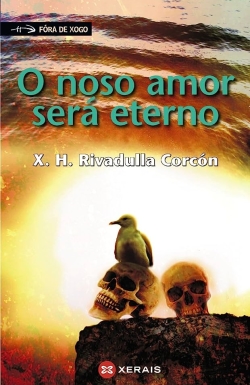
Once the object was on board, Xosé picked it up without realizing what it was. When he did, he jumped and let it go, letting it roll across the wooden planks. The object was a human skull and it rolled until it hit Ramón’s feet, who then picked it up and looked at it carefully.
Xosé and Luís told him to throw it back in the sea, it was bad luck to touch these kinds of things, but Ramón preferred to keep it in his basket and take it home.
“As the years pass, we are becoming more and more weird,” Luís said to him.
“As the years pass and as our solitude grows,” replied Ramón.
Back home, the old sailor cleaned and dried the skull, then put it on the bookcase alongside all those other objects he had collected from the bottom of the sea. Then he looked out to the water from the window in his lounge. That day there seemed to be more seagulls than normal and they seemed quite restless.
Ramón got up and moved towards a record player he had in the room, turned it on and a song by Atahualpa Yupanqui, “Los ejes de mi carreta”, began to play. He went back to the window and stood there, looking out at the sea, listening to the music.
When the melody stopped, everything fell silent and Ramón thought back to some verses he’d read somewhere, though he couldn’t remember where or who they were by. Almost whispering he recited the following words:
Black flag of mourning
Flies at the inn adrift
For the sailors who died
Over so many years out at sea.
The anonymous skull from the shipwreck had brought these verses back into his mind.
Text © X. H. Rivadulla Corcón
Translation © Harriet Cook

 Portico of Galician Literature