
Synopsis
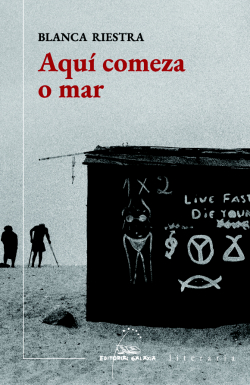
Here Begins the Sea (246 pages) won the Blanco Amor Award for long novels in 2021. It is Blanca Riestra’s second novel in the Galician language and is divided into five parts.
In Part I, the narrator, a woman, describes the bars where people used to hang out in Coruña, “the second capital of Francoism”, in the last decades of the twentieth century, through the eyes of characters such as Vari the photographer, Nikopol the poet, Cabanas the painter and Pedro, with his interest in numbers. It was a time when people died of an overdose, AIDS, or committed suicide. There was the punk bar Estudio 1, the rockers’ bar Marilyn, the psychedelic bar Mar Adentro and the jazz bar O Filloa, among others. The city is built not on a volcano, but on a sewer. Alberto Ramos points out that under the city is a river, the Monelos. The narrator takes photos of drains, expecting to find hands clinging to the grates, but all she finds is rubbish, old newspapers, mud. There is also a myth that the city is built on the head of Hercules, which two saints, Brendan and Amaro, put out to sea to find. When she is still at primary school, the narrator meets up with a friend, Helena, in an area called Miramar, which back then was full of brambles and needles, but is now a disco. Thirty years later, the narrator is staying in the Czech embassy in Delhi, wondering what she is going to do with her life. Everything is difficult. She meets an Austrian writer and thinks men become caricatures of themselves.
Four Galicians – Manuel Rivas, Lois and Xosé Manuel Pereiro, Santiago Romero – share an apartment in Madrid. The Virgin of El Rocío pays them a visit, entrusting them with the mission of upturning the old order, which they understand in different ways. The narrator and Helena hope for an erotic Galicia and fall in love with the poet Lino Braxe. Meanwhile, the poet Lois Pereiro has returned by now from Madrid, having fallen ill because of some adulterated cooking oil. Amancio Ortega, the founder of Zara, shares his dreams with his wife, Rosalía. The drug trafficker Laureano Oubiña receives the visit of a youngster, Vladimir, who says a dark spectre with black wings is going to overwhelm Coruña. And the narrator, at the age of seventeen, protects her virginity as if it was a chalice. Nothing is permanent, which is what a coloured boy discovers when his first relationship comes to an end or the narrator discovers when her brother, Javier, who used to look out for her, disappears.
The narrator, Miranda and Raquel sit down to work out how long it would take to kiss all the boys. They reckon it can be done by summer, at which point they can go camping or visit Paris. Toñito is concerned that cannibalism is overtaking the country and middle-aged women are sending loose heads by registered post. The narrator visits the disco Punto Tres, where Toñito is the undisputed star, she swaps drinks for vinyl records, and it is better to listen to the music while vomiting in the toilets. The ghichos were small-time criminals who went to the Ensanche on a Sunday to hold up kids from good families and get some money to buy tobacco. Some of them were very attractive. The narrator is still in love with Toñito, who doesn’t have long to live, but he won’t touch her.
In Part II, it is June 1988. Galicians love the night because it is the perfect place to drink. X is 18, studying law, and going out with men – nationalists, accursed poets, suicidal rock singers. She kisses as many men as she can, but is still a virgin. She finds herself with the most famous drug addict in the city in her living room. The narrator chats about amputated legs and the virtues of gangrene. It is as if she has a papier mâché head that protects her. Lois Pereiro writes poems in English and then translates them into Galician and Occitan. He writes letters to his girlfriend. There is no more powerful love than an uninterrupted conversation about the world. In the law faculty, Helena shows off her black bra under a white T-shirt. She will become a famous feminist thinker. Friday is the only day they feel free. Three women meet up on a patch of grass overlooking the sea. They drink and smoke. In the night, a mother gets up to find her daughter leaning over the toilet, her make-up all smudged and her hands stained by tobacco. She asks if she needs help, but the daughter says that everything is fine.
X attends a Prince concert. She wants to live abroad. Her friend Paco reassures her that the night, bars, friends, will always be there and time passes slowly. Lois Pereiro says he will never be separate from his girlfriend. He recalls Guillaume Apollinaire at Verdun, Louis Aragon also in the trenches, reading Rimbaud, and how Apollinaire died just as the First World War was ending. Toñito wonders whether Coruña isn’t, in fact, hollow. He says to the narrator that she will survive because she is protected by fear. She remembers the decade that Amancio Ortega spent trying to secure funding for his project, Inditex, but nobody believed in him, except possibly for some smugglers. The narrator’s brother, Javier, visits the painter Tim Behrens at two in the morning to ask how to make ochre. The narrator professes an idolatry of the present moment – this is her church and religion. She thinks there is a kind of sucker that keeps her in the city, which she has started to hate.
In Part III, they go to study linguistics in Santiago and decide if everything was linguistics in this life, the world would be much easier. They eat potato omelettes and smoke until late. The body with its hands and mouth is the antenna of the spirit – if the spirit exists. There is then a period which X spends in France. With Marta and Margot, they visit the east of France and spend their grant money on booze. In May 2001, X arrives in Madrid. She is alone, and her loneliness makes her furiously happy. She stays with her sister and meets the novelist Gonzalo Torrente Malvido and the inventor of table football Alexandre de Fisterra. The light there drives her crazy. Her only problem is money. Looking back, she is not sure she was telling herself the truth and what she considered to be luminous days were in fact built on foundations of sand. You will be left alone and poor, says the world. However hard you try, you will lose. The worst tragedies were the deaths of her father and brother. She has a daughter with her partner, León. Having a child is like having a Lamborghini, it produces the same euphoria, but is also within reach of the poor. Very little is left of X, just a few minutes before going to sleep to remember who she was.
In Part IV, she returns without work to her city. The child makes her happy, but also does her harm because she empties her of herself. X is worried that her whole person will disappear. The narrator’s aunt compares the world to an opera and says only charity can save us, getting rid of oneself, like taking off a disguise. X wants a brother for her daughter, but ends up having a series of miscarriages. She tries in vitro fertilization and imagines her body like an enormous fish tank. She imagines her embryos are aquatic creatures that cling to the keel of a boat, while the fishermen throw bread crumbs and bash them with their oars, so they won’t hold back the boat. She visits the filmmaker Angeles Huerta, who tells her things she couldn’t tell on film. X visits a bridge over the River Monelos, for which she has to wear a mask and suit, since the sewers can be dangerous for those who live on the surface. She comes across the bridge, which would once have been in a meadow, but is now buried under cement.
X has the impression that León no longer loves her because he is constantly shouting at her and complaining. To avoid arguments, she starts talking less. She feels as if her hands and feet have been bandaged and she can no longer use them. She misses her father, who used to explain things and tell her what to do. People haven’t changed. They still send their children to religious schools and drink aperitifs. Inditex has transformed the city, but despite his wealth, Amancio Ortega misses the first-floor apartment he shared with his wife Rosalía, who has died. X feels she is living through her civil death, everything leads to dissolution, not to plenitude, though we are told that the opposite is true. She comes across someone called Lalo in Coruña, their paths cross, but they express no interest in each other. When X appears in public, she is absorbed in a book. Lalo later tells her it looks as if she neither wants to speak nor to be spoken to.
X’s mother begins to lose her memory. She becomes stuck in the summer of 1935. X’s relationship with León deteriorates. She feels like a second-class city. She accepts her condemnation. The world tells her she won’t get out of this alive. She would like to be something, but has the impression the world is erasing her name and surname with bread crumbs. At the end of the year – 2018 – she goes out with some girlfriends and fantasizes about killing a sea of masculine heads with a Kalashnikov. In a bar where Bowie is playing, her friends introduce her to Lalo, and the two of them get talking. When she gets home later that morning, it is the last time León and she make love. The next day, she hears a taxi phone ringing and is tempted to pick it up. She thinks someone might be calling her from the future to warn her about something. She has the impression that Lalo is a character she has invented. She is irresistibly drawn towards him. She finds in him her life before she became an adult. It takes them more than a month to kiss. She moves in with her mother. In the end, she goes to his house and they make love.
The beginning of the end happens one spring. She passes the civil service exams, which she only sat in order to spend time with him, but he doesn’t. She gets her divorce, but begins to feel alone. He confesses that he doesn’t love her anymore. She feels she can no longer reach him and leaves. Everything we receive is taken away from us in the end. Nothing is given to us to own. Her daughter wants to play, wants her to be happy with the life she has, but X feels terribly alone. She finds it difficult to smile. She writes commonplaces in her notebooks, which are just outpourings of her affliction. The city changes, recent memory quickly disappears, but we don’t let go of our memories from before we became adults. X doesn’t want everything to slip into non-existence, she doesn’t want everything to sink into the mud of nothingness. She thinks if Lalo disappears in her, he will disappear in the world, because she is the one who projects him. She is the world’s projectionist. Her daughter has turned into a warrior. They live together like students. She hears of the death of a friend and suddenly feels proud of the distance she has covered.
In Part V, X feels that every moment away from Lalo is wasted and she finds this unjust, like sprinkling white bread with bleach. It makes her happy, if she glimpses him in the park, to know that he exists. When she goes to the district of Martinete, she sees the spectre of the River Monelos, which used to run between meadows and is now a sewer. Her friend Marta in France tells her to seek distractions. She takes pleasure in routine, in helping her daughter to study, in continuing to write this novel. She starts to forget, which means throwing half your life in the rubbish. She asks a friend, Sanz, if limits exist. The friend replies that the only limit is language. Language is what makes things worth telling. When she passes in front of the disco Punto Tres, which is now closed, she finds it much smaller than in her memory. She goes to see an acquaintance from her past, Parque. She almost doesn’t recognize him when she waits for him outside his place of work. They go for some beers, and Parque talks about his earlier life as a musician. In the beginning, it was great, they received a lot of attention, but gradually he started to mistrust people, the group of musicians didn’t know what to do with their gift. One time, by the sea, he saw a school of mullet and thought there was a child among them. He had the impression that the child wanted to talk to him. His partner, María, left him for Lalo. Now he does what he can not to feel pain. X reaches the conclusion that nothing makes sense, nothing matters. Her cure is to accept that she is alone. She finds a notebook in which she has noted down her wishes for New Year 2019 – lucidity, confusion and nocturnal brightness, also capacity for work – and realizes that all her wishes have come true. 2019 has been the most difficult year of her life, but it has had moments of euphoria and delight. Her boatman has been Lalo, who has deposited her on the other side and gone back for more passengers. She meets up with him again, but they fail to make real contact. She thinks perhaps her feelings for Lalo were just love for her own discourse, which needed him to take form. She concludes: we write because non-existence frightens us, to drive non-existence away.
This is a highly personal and philosophical take on the Coruña of the end of the twentieth century and beginning of the twenty-first, places and people that have since changed, like Parque, or disappeared, like the narrator’s brother Javier. It is a defence of memory as a bulwark against non-existence. The city changes, but underneath it can still be heard the soft, sweet voice of the sewer, which once was a river. It is an expertly written narrative full of local and universal references that would interest anyone with an insider’s knowledge of Coruña, but also anyone with an interest in the purpose of literature. There is a lot here that is geographically specific, but a lot that relates to the common human experience. Here Begins the Sea merited the Blanco Amor Award in 2021 and is Blanca Riestra’s second novel in the Galician language.
Synopsis © Jonathan Dunne

 Portico of Galician Literature