
Synopsis
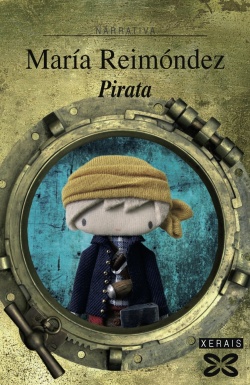
Pirate (344 pages) is a novel about the love affair between two women pirates, Mary Read and Anne Bonny, whose lives were recorded in the 1724 text A General History of the Robberies and Murders of the most notorious Pyrates by Captain Charles Johnson. In wider terms, it is about the right of women to take their own decisions and not to be defined by others’ perceptions.
Mark Read sits on the deck of a ship and contemplates the solitude of being at sea, observes his hands, strong hands, aware that a calm often precedes a storm. He remembers how, when he was a child, the crew warned him away from the quay in case he got caught and put aboard a ship, but that was what he wanted, to escape, for him prison was the land. They told him stories about great wealth plundered at sea. There is a party below, and Anne Bonny comes up to invite him to join them. He says he may come later, not now, he wants to continue observing the solitude, to make up his mind, to find the right words if he can. He remembers when, on New Providence Island, he first set eyes on Anne. They were in a tavern, and Mark had gone there to drink, not because he liked to drink, but because it was a good way to observe what was happening and pass unnoticed. Anne was outspoken and almost got into a fight with another woman, but her enthusiasm was curtailed by a certain Madame Ebony, who seemed to be able to read Mark’s mind and anticipate his desires. He was disturbed when he saw Anne plant a kiss on the lips of the woman she almost had a fight with, but declined to dance with her and hid beneath his hat.
Some of the pirates reminisce about Edward Teach, ‘Blackbeard’, and the Blockade of Charleston. Anne says she was there, and this taught her the need to be free. Mark also wants to be free, free of the prison of serving the King, free of the prison of having to do what he’s told. Mark recalls how he fought for the King in Flanders with a soldier named John Fleming, who believed in his country. Mark, on the other hand, fought for himself, so that he could take his own decisions. He remembers how, in New Providence, he shared with Anne a desire for freedom, the will not to be trapped in his own body, and first met the pirate Jack Rackham, rumoured to be Anne’s lover. Madame Ebony had seen how Mark looked at Anne, but was more concerned with how Anne looked at Mark. That was why Jack left him on land. She encouraged Mark to follow Anne wherever she went and talked to him about tribades. She then took off her clothes so that Mark could touch her naked body and learn who he really was, touch his own freedom. Life is short, and he doesn’t want to be a silence. When Anne returns to deck from the party, he takes a decision and gives her a kiss. Anne invites him down to the captain’s cabin. Mark hesitates for a moment, begins to say something. Anne replies that she already knows. Mark Read – Mary Read – is really a woman. This is the end of the first part of the novel, ‘Blue’.
The second part, ‘Red’, is divided into six separate chapters. In the first, after boarding a ship that puts up no resistance, Mark and Anne come together again, search out each other’s bodies, but are caught by Jack, who is surprised to discover that Mark is actually a woman. Jack leaves them to sleep in the cabin. Mark remembers again his days as a cavalryman, alongside John Fleming, for whom he felt a strong attraction. What others thought was a wound turned out to be his period. He had to change the cloth he was using to soak up the blood, change his trousers. At night, he went into the forest to be on his own, to try to resist his attraction for Fleming. He is roused from his thoughts by a kiss from Anne. When he returns to where he should have been sleeping, another crew member tells him to be careful with Jack and assures him that he has the support of the rest of the crew. Mark wonders what it would be like to tell the crew he is a woman. He again remembers how the other soldiers in Flanders found him strange, the way he sought refuge in the forest at night. Fleming was worried that he had offended him in some way, until he went to him in the forest at night and Mark revealed his true self. Fleming and Read then got married and opened a tavern, but Mary could not get used to her new life as a married woman. On their wedding night, she didn’t bleed. Fleming asked if she had slept with another man. Mary replied that she couldn’t have, after all she’d only been a woman for a couple of months (it was Madame Ebony who told Mark about the hymen and how it could break for reasons other than sexual intercourse). The people in the village found her strange. She couldn’t get used to a woman’s clothing, to speaking with a woman’s voice. In the end, she ran away, went back to being Mark Read. That is why she is now afraid of becoming Mary again in front of the others.
In the second chapter, Mary reveals her true nature to the other members of the crew, who aren’t that interested. They spot a merchant ship in the distance and decide to play a joke by pretending to be a ghost ship. Travelling on the merchant ship is the author Charles Johnson, who is keen to write a book about pirates since everybody has been fascinated by them ever since the death of Blackbeard. When they board the merchant ship, Mary is frustrated that no one puts up a fight and goes about punching anyone she can find until another pirate tells her to calm down and taunts her for being a woman. Mary is not bothered, she now knows to keep an eye on this pirate, Richards. Meanwhile Johnson reveals to Jack his intention of writing a book about pirates. Jack is pleased and invites him to talk to all his boys… and girls. Johnson is surprised to discover that his best men are in fact two women. Anne and Johnson get off to a bad start. Anne suspects his motives in wanting to write a book, she thinks he has other interests, such as making money and becoming famous himself. Johnson, however, is more interested in Mary, who continues to dress as a man. Anne recalls her past as the daughter of a rich merchant, how men came to ask her father for her hand, but she wanted to follow her own path. Anne is convinced that men will always treat women as they want to, interpret them according to their own wishes. Mary, on the other hand, is keen to tell her story, not just to live in the moment, but through Johnson’s writing to live on in the future. When Anne is asleep, Mary comes to an agreement with Johnson to tell her story just as it is, including her love for Anne, their relationship. Johnson agrees, although he is not sure he will be able to stick to their agreement and feels he is duty-bound to save Mary from the unpredictable Anne.
In the third chapter, Mary Read tells her story, how she was born when her father was at sea, how her elder brother, Mark, died and, in order not to lose the money they were receiving from her paternal grandmother, Mary took Mark’s place and pretended to be a boy. She remembers their visits to her grandmother, for whom Mark, as a boy, was the apple of her eye, while her other granddaughter, Louise, was a good-for-nothing. When her grandmother died and there was no more money to be had, her mother told Mary to dress as a girl, to stop being a stable boy, which she had enjoyed, and to become a serving girl instead. Mary missed being a boy, wearing trousers, running around, talking in a loud voice. She didn’t want to be condemned to stay at home and get married. One day, when she was sent by her mother to buy some cloth in London, a young man on the coach offered to see her safely home, but tried to rape her instead. Mary fought him off, stole some male clothes from the neighbour, took what was left of the money for the cloth and ran away. At the age of thirteen, she worked on one of the King’s warships as a cannon boy, learned how to wield a sword and was introduced to the art of navigation by the captain. She then joined the King’s infantry in Flanders, went back to riding a horse in the cavalry and finally got married to Fleming. She missed the sea and joined a Dutch merchant ship travelling to the Indies, which was boarded by pirates, among them Jack Rackham. That was when she became a pirate, on board the sloop Ranger, whose captain was Charles Vane. When the pirates boarded another ship, Mary went first and came away with a stack of weapons. She enjoyed the camaraderie, the chaos, her share of the booty. On a trip to New Providence, known as the ‘pirates’ republic’, she met Madame Ebony. At one point, Johnson offends Mary by referring to Anne as an ‘anomaly’. As a result, Mary stops telling him her story, and Johnson begins to realize he misses her gestures, her presence, and may have fallen in love. He still wishes to save her from what he sees as the corruption of a pirate’s life and finds it impossible to accept that she can love another woman.
In the fourth chapter, the pirates, at Mary’s instigation, vote to return to New Providence in order to careen the ship. Mary feels she owes Madame Ebony a great deal and wants to see her again. She enters the town at night, dressed as a woman in order not to arouse suspicion and end up being arrested as a pirate. She finds Madame Ebony in bed, in the grip of a fever. Madame Ebony warns Mary that she is not safe in the town and must leave. She gives her a sheaf of papers on which she has written the story of her life, which Mary cannot read, but is prepared to carry with her wherever she goes.
In the fifth chapter, Anne reads what Madame Ebony has written to Mary. She writes that she knew Mary was a woman as soon as she set eyes on her in the tavern. She reveals how her mother used to tell her stories about her native Africa, before she was made a slave and forced to pick cotton. She wanted to be a healer in the village and remain single, but in the end she had to run away, was captured by slave traffickers, put in a box and shipped across to the Indies. When Madame Ebony reached a certain age, she was taken to the marketplace to be sold as a slave and was separated from her mother. She was sold to a doctor and made to clean, but the work was not as heavy as it had been on the cotton plantation. One day, the doctor discovered her cleaning in the library, observing a book, and asked if she could read. When she said she couldn’t, he said a new patient of his, Annette, would teach her how to read and Madame Ebony would be her servant. Annette was not much older than Madame Ebony and dressed in a jacket and trousers, much to her surprise. She had been sent to stay with the doctor because of her desire to wear trousers, to go places on her own, to ride a horse, not because of an illness. Together, they read Ovid’s Metamorphoses (in particular the story of Iphis and Ianthe) and later discovered each other’s bodies. They also discovered a list of books in the library that talked about lesbianism, books by Nathaniel Wanley, Jane Sharp, Margaret Cavendish, Nicolas Venette, Sappho and Aphra Behn. They dreamed of a future life together, but one day Annette’s parents appeared. The doctor assured them that his treatment of Annette – reawakening her natural instincts by getting her to teach a slave, an inferior creature, how to read – had worked and Annette had given up wanting to wear trousers (in fact she wore dresses so that Madame Ebony could touch her more easily). Annette, however, insisted on taking Madame Ebony with them, which her parents would not accept. Madame Ebony tried to go after her but, when she reached Annette’s family home, she was told that they had moved back to England. By now, she was free, she had run away, and she decided to go somewhere where the normal rules did not apply – New Providence Island. When she arrived at the tavern, the owner, Madame Emerald, offered her work as a prostitute; Madame Ebony asked to work as a healer, like her mother. After Annette, her only love was Mary, but she realized that Mary’s path was another and she had eyes only for Anne. The important thing was to tell their story, so that other women could follow their example.
In the sixth chapter, Richards, the pirate, discovers one of Madame Ebony’s handwritten sheets and accuses Mary of hiding information about a treasure. Johnson is invited to read the sheet out loud, but Richards accuses him of partiality, and Johnson challenges Richards to a duel. Mary says that she will fight in place of Johnson (who she thinks will not survive a duel), and Richards accepts. The duel will take place as soon as the ship touches land. They come to an island, where Mary mortally wounds Richards, and they bury him. They then come across a sloop, which they board, but the crew puts up resistance and one of the pirates, Noah, loses an arm. Mary helps Anne bandage up a wound, then kisses her body. Johnson continues to try to persuade Mary to adopt a different life, one more suited to his way of thinking; he also tries to persuade Anne to stop corrupting Mary, as he puts it. On neither account is he successful. Mary is sorry that she ever began to tell him the story of her life and is glad that there are several gaps in her account. Johnson, though a prisoner, wishes to escape from the boat, he has had enough, and, despite his feelings for Mary, he doesn’t want to look back. When the crew offloads some prisoners, Johnson goes with them, but Mary has the impression it would have been better to keep him with them because their paths will cross again. Later, the crew brings a prostitute on board. One of the pirates, James, is too close to the woman for Anne and Mary’s liking, Anne shoots him dead and they allow the woman to return to her boat, but the crew is not happy with the punishment, so Jack says the two women’s share of the next booty will be divided between the rest of the crew. Later, Anne confesses that she couldn’t bear the cries of women in her home when they were assaulted by her father, or the silence of women coming to ask for her father’s hand in marriage after her mother died. They are pursued by another sloop, captained by the privateer Jonathan Barnet. They think they have escaped, Anne confesses the happiness of her life with Mary, then they hear the creaking of a falling mast. Anne, Mary and Jack put up a fight (the rest of the crew is too intoxicated), but they are overwhelmed and arrested by Barnet. Among the men on Barnet’s ship is Johnson. This is the end of the second part of the novel.
In the third part, ‘Black’, Mary and Anne are accused of piracy. They plead not guilty. In prison, Jack is allowed to say goodbye before being hanged. The prostitute they saved testifies against them. Johnson accuses Anne of being a dissolute woman, but tries to defend Mary, whom he portrays as a victim of circumstance. When Johnson visits Mary in her cell, Mary is furious that he has twisted her words and grabs him by the neck. She then succumbs to a fever. They are visited by Madame Ebony, who gives Anne some herbs for Mary. She advises them to ‘plead the belly’ should they be convicted. They are sentenced to death, but claim to be pregnant, and as a result the sentence is suspended. Mary sees black death approach and is ready to fight, but quickly surrenders.
In a short epilogue, Anne and Madame Ebony bury Mary in the prison cemetery and then swear to find Johnson and wipe him off the face of the earth. Pirate, set in the Golden Age of Piracy (1650-1730) and based on real characters and events, is a passionate cry for the right of women to define their own freedom instead of being forced to accept the role given to them. The author skilfully adopts the guise of a historical novel to address issues of feminism and gender identity.
Synopsis © Jonathan Dunne

 Portico of Galician Literature