
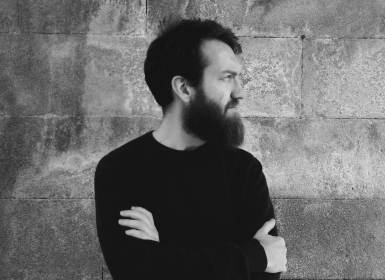
Biography
Abraham Pérez is a Lugo-born writer who has explored different literary genres. He studied philosophy in Santiago de Compostela and screenwriting in Madrid. His poetry collections include Fragment/Break (2020), a theory for spectres (2021), toxicity (2022, shortlisted for the Francisco Añón Poetry Award), and the transparent body of hours (2022). He has published an essay, Silk Hoe (2023), and a journal, Petrol-Stained Seagulls (2024). His novel The False Step (2023), a portrait of an artist who moves between Santiago de Compostela, Lugo, and Madrid, and a critique of a generation affected by the economic crisis, was shortlisted for the Torrente Ballester Award for Galician-language fiction and for the Illa Nova Award for writers under the age of thirty-five. His work has been translated into French, Portuguese, and Spanish.
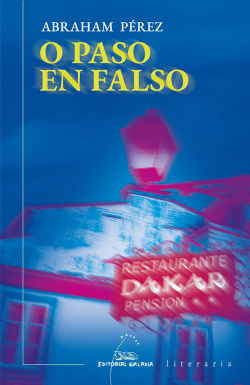
Synopsis
The False Step (178 pages) is Abraham Pérez’s first published novel and is divided into four parts. In the first part, “Improvised Music”, the narrator studies English philology in Santiago de Compostela. He is due to fly to Dublin the following day to visit his brother, Roi, who is there for a year. He arranges to meet Laura, his friend Xavier’s girlfriend. He’s not quite sure why he has done this, since he doesn’t believe they have anything in common. They go for some drinks, end up having a reasonably good time, and at the exit of one of the pubs Laura tries to kiss him. The narrator resists and decides not to tell his friend Xavier about the incident.
Sample
I have always said I was incapable of taking anything seriously. I try to reduce everything to absurdity, to a comic, trivial moment, which ends up being manifested in a round of unhealthy guffaws. But last night’s unease causes me to rethink this naive facet. My body swings between the heat typical of certain kinds of dizziness and the cold of this March morning. In the end, the coldness of the bathroom floor isn’t what disturbs me most – rather part of the discomfort comes from contact with the small, turquoise-coloured tiles that overlay it. I must have marks on my knees, and yet I cannot get up because everything is spinning and I feel like vomiting.
The floor ends up getting wet. My body can’t take any more and needs to expel all the alcohol it has inside. A quantity that was ingested as if I had placed a funnel and simply started swallowing. I cannot deny that the afternoon was conducive to this. My innocent intention had been to go and print the tickets for the flight departing this afternoon for Dublin, where my brother is waiting for me. And yet everything got complicated when, minutes prior to leaving the hall of residence, I received a message from Laura asking if I fancied meeting up. Days earlier, as I came out of Maycar with a couple of colleagues, she had seen me and come over to talk to me. She was with some female friends, whom she introduced me to – I can only remember Iria, a dark-haired girl with green eyes who, when I greeted her, smiled copiously. Since I had no more excuses to give, I agreed, endeavouring to convince myself that, with nothing better to do, it wouldn’t be bad to drink a coffee, discuss Iris perhaps, and then, towards nightfall, go back to my room and rest up for today. Obviously, plans, more often than not, do not work out as foreseen. All idyllic – and, in some cases, rational – constructions do not cease to be a mirage: the old idea of projecting ourselves as we would like to be. A mistake that is repeated over and over again.

 Portico of Galician Literature