
Synopsis
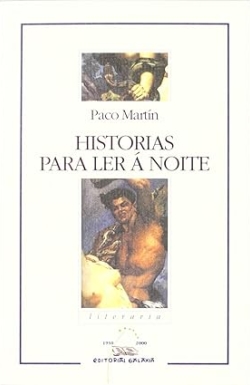
Stories to Read at Night (160 pages) is considered one of Paco Martín’s best story collections. It was first published as three stories in 1992 and enlarged to four stories in 1995. In these stories, ordinary situations suddenly appear strange or disturbing.
In the first story, “The New Fire”, the narrator and his friend Gaspar are trying to find Mr Mirión to ask him a favour. He has a “monoxylon” – that is, a single, upright stick – in his yard, which they would like to burn in the “new fire” for St John’s Eve, when it is traditional for people in Galicia to light and jump over bonfires. The stick has not been upright for 23 days, it has been lying down. Similarly, no one has come to the commune where they live, nor has anybody left. It is customary for Mr Mirión to leave the commune before St John’s Eve and not to return until the reaping season. But this year, he has stayed.
Mr Mirión arrived in the commune one winter, two years previously, saying he was a native of the commune – he and the village were one – and he was returning to live in the house on the cliff. The following spring, two old women and their younger brother, Severo, also arrived in the commune. Severo wasn’t in his right mind and would sit on a stool in the shed watching his sisters go about.
One day, blonde Margot went mad and shut herself in her house. She appeared at the upstairs window, her breasts streaked with blood, asking for one of the old women, Dosinda, who came running. It turned out she had broken a mirror with her iron and didn’t know what to do about it. The boatman, Simón, took all the mirrors from the houses and dropped them into the middle of the reservoir that separated the commune from the outside world.
While they are waiting, Gaspar confesses that he has hid the large wardrobe mirror from his father’s bedroom under the dry bedding in the stable. He knows the narrator is in love with his sister, Mireia, and hasn’t seen her for six months. He explains he found her with some new gold earrings and she went into their father’s bedroom, where the mirror sucked her up, and she is still in the mirror now. The narrator is very moved.
Mr Mirión comes out of the house and says they can take the monoxylon to burn in the bonfire. They return with it to the village. There is an unnatural silence. They light the fire and put the monoxylon in it. Mr Mirión is there. So too is Gaspar’s sister. The two old women seem to plead with Mr Mirión, who takes no notice. One of his shoes catches fire, and the fire spreads to his trousers, revealing the leg of a he-goat. All the other villagers bring their bodies to this “definitive fire”, which seems to have existed since time immemorial just for this purpose.
In the second story, “Fina”, the narrator has been a doctor in his native town for nineteen years. His father was a doctor before him, his mother the daughter of the local lord. He had a lot of possibilities as a child, which included hunting with his father and the dogs Spot and Sultan, and studying Medicine in Santiago, so he could take over his father’s surgery. We hear about the breakdown of his marriage to Rosa.
He writes a letter, dated 16 October, to Rosa, their daughter, Siña, and several other acquaintances to explain recent events. In this letter, we learn that when he started his practice, one of his patients was a little girl called Fina, who had a case of mumps. The girl formed an attachment to the doctor and used to visit the house, but when the doctor got married, she stayed away.
Four years previously, however, she reappeared in the company of a blond man named Manolo to invite the doctor (without his wife) to attend their wedding. Three years later, she reappeared on her own and explained that they had been unable to have a child and she wanted the doctor to give her one. The doctor tried to persuade her to see a gynaecologist and also informed Manolo, who then took off to Switzerland.
Returning from Coruña one night, the doctor saw Fina in a meadow by the river. He was worried and visited her house, where her father explained she didn’t sleep and would go walking by the river at night or sit by the fountain in Regomozo. She also visited a healer named Red in Betanzos on Friday nights. The doctor met up with two friends who had also had strange experiences with Fina. One was the vet, Marcial, who had seen her by the fountain at night in a violent embrace with someone or something. The other was the local head teacher, Ramiro, who had been giving Fina a lift to the local garage when Fina had caught him looking at her legs and said she didn’t mind if he wanted to go further, but he was afraid. They are all attracted to her.
The three friends determine to visit the healer Red in Betanzos. He welcomes them and gives them a delicious red wine to drink. He explains that he had been waiting for someone like Fina to arrive for nine years and warns them against having anything to do with her, saying she is outside their influence. He leaves Betanzos the very next day. The three friends ignore his warning and go to the river at night. They see Fina arrive at the fountain, walking weightlessly over the grass, and get undressed. A child then appears, who drinks greedily from her breasts, as if sucking out her soul. The men are disgusted. When Fina leaves, Marcial smashes the child on the ground until it is dead. Its penis and testicles seem to have grown. They drop it in the river.
The next morning (the day the doctor is writing his letter), the sergeant’s son comes to tell them that a man has turned up dead next to the pool where they dropped the body. It is Amable de Cidro, who used to go fishing there, with a look of horror on his face. The three friends go to visit Fina at home. The doctor is admitted to her room and examines her, only to discover that she is clinically dead. Here, his letter ends. He is due to meet up with his friends later that night.
The letter is followed by two notes. One is from the bishop’s office. They have received a copy of the letter and requested further information from the parish priest. The other is from the parish priest, who informs the bishop’s office that the doctor, Don Leonardo, has been missing since the 17th. So too has Marcial, the vet, although he phoned his mother on the 26th. Ramiro, the teacher, has been on sick leave and was admitted to a psychiatric clinic on the 25th. Fina has also been missing since the 17th. It is believed that she has made off with the doctor, since he has withdrawn the totality of his savings and his best car has disappeared.
In the third story, “Pitchfork”, Silvio Moreiras is a well-known composer who uses others’ material to compose songs that are easily remembered and also easily forgotten. He is married and has two children. He is having an affair with Rita, whom he meets away from his family and introduces to people by a different name each time. He has arranged to take her to a friend’s house in the country – in order to break up with her, since there are other women he is interested in. They meet in separate cars outside the nearest town. Rita leaves her car and gets in Silvio’s ATV. On the way to the house, Silvio makes her lie down in the back, beneath a blanket. He picks up the estate manager, Edelmiro, who takes him to the house, where he plans to remove the two guard dogs, only to find that the bitch, Pearl, has killed the male, Pinto, by ripping out his genitals. Edelmiro says he will have to kill the bitch, because she has obviously gone mad.
When they arrive at the house, Silvio gives Rita some flowers. Rita is suspicious – it is the first time he has done this – and correctly assumes he is going to break up with her at the end of their stay. In the kitchen, she spots an insect scurrying across the floor. It is an earwig, also known as a “pitchfork”, as well as other names, and she notices that whenever she strokes it, it grows by a couple of centimetres.
She goes upstairs and lies naked on the bed, while the earwig walks all over her. By this stage, it is the size of a kitten. She puts it in a bag and goes for a swim in the outside pool. Silvio joins her, and they make love (she with her hand in the bag containing the earwig). Silvio remembers that they used to call the insect a “willy-cutter” when they were little.
He goes to work in the library and composes a new melody, which he believes is his life’s masterpiece. He doesn’t want to have dinner, but carries on working and then takes some pills before going to bed. Rita clears away the dinner and burns the food and flowers in the incinerator in the kitchen. She and the earwig play an erotic game. The earwig is enormous by now.
She then takes all her things and burns them in the incinerator, keeping only the clothes she is wearing and a rucksack with her most valuable possessions. She burns the bag that had the earwig in it and the papers on which Silvio has written down his new melody. She then releases the earwig at the foot of the stairs leading to the bedroom where Silvio is asleep and leaves the house, planning to walk the ten miles to her car, where she hopes to arrive by the next morning. On going past the estate manager’s house, she hears the bitch, Pearl, barking and realizes Edelmiro hasn’t had the heart to kill her. She is glad and determines to adopt the bitch’s name, Pearl, in front of her friends.
In the fourth and final story, “Motorway”, Milucho works as a tour guide for a travel agency – unofficially, cash in hand. He specializes in excursions for older people and knows how to get them to spend a little extra money. He is not against comforting some of the older single women who are looking for a little attention. Two hundred miles after the start of their journey, the bus they are on breaks down beside the motorway because of a faulty connecting rod. The older driver, Román, goes to seek help, but returns in a taxi without any. Two of the passengers determine to leave in the taxi, and the two drivers join them.
Milucho is left alone with the rest of the group. He tries to use the microphone to address the group, but it doesn’t work, and the passengers end up laughing at him. There are very few cars on the road, and they haven’t been able to ascertain where they are. It is as if the road doesn’t exist. Another seven passengers get out and are picked up by a dark van, which drives away before Milucho can ask them to bring them some water. Most of the remaining passengers also get out and form an orderly queue on the tarmac, in the hope another vehicle will pass and take them away from this place. It is extremely hot, and the air conditioning has stopped working.
Left on the bus are Milucho, a lame soldier who lost a leg in the service of his country, an attractive woman in a safari jacket, a retired Maths teacher who lives in Paris, and two nuns. Milucho and the woman discover four small bottles of beer in the drivers’ fridge, together with some melted ice. The soldier grabs a beer, sticking his hand in the melted ice, which they are going to have to drink, and is upbraided by one of the nuns. He says he has a right to take things because of losing his leg, but the older nun reveals she was a nurse at the military hospital where he was treated and knows very well the real reason for his amputation, which is shameful.
The nuns take the fridge with the melted ice outside for the other travellers to drink. The mathematician has been keeping notes about the journey in a notebook, the pages of which he takes to burn outside the bus. Milucho and the soldier watch as the remaining passengers set off down the deserted motorway, leaving the upturned fridge behind. Only the four of them are left now when the bus’s video screen sparks into life and a metallic voice begins to tell them what they must do.
Stories to Read at Night is an excellent collection of stories containing elements of the supernatural. In all of the stories, there is something unusual – the attraction of the bonfire on St John’s Eve, the strange child feeding at Fina’s breasts and the fact she is clinically dead, the earwig that grows to an enormous size on receiving Rita’s attentions, and the bus that breaks down on a motorway that isn’t supposed to exist. The author, Paco Martín, reveals himself to be a consummate narrator in the Galician language, with a deep knowledge of Galician folklore and openness to events and circumstances that seem to surpass the boundary of what is normal.
Synopsis © Jonathan Dunne

 Portico of Galician Literature