
Synopsis
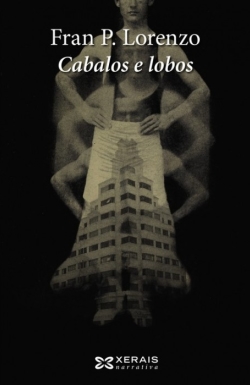
Horses and Wolves (192 pages) won the Blanco Amor Award for long novels in 2014. It is set in the city of Vigo in the present and during Franco’s dictatorship. The Beckmanns are a family who have done well under Franco’s regime, but the family hides many secrets, which Paula does not want to leave as a legacy to her son.
The book is divided into three sections. The first is Paula’s address in Vigo: “Gran Vía, No. 2”. This section is divided into twenty chapters. The first chapter is a flashback to the summer of 1960, when Paula’s father, Ramón Costa, committed suicide by throwing himself from the eighth floor of their building. The narrator is Paula Costa Beckmann, and she was only three at the time. Her mother, Gloria Beckmann, would then live years of bitterness. In the second chapter, we have fast-forwarded to the present. Paula’s doctor, Dr Quirós, is worried about a dark patch on an X-ray of her lungs and would like to conduct a bronchoscopy. She smokes too much. Paula returns home and informs her mother, who suggests she keep it from her son, Thomas, since he has his exams. Paula sifts through photographs from 1959 or 1960, before her father committed suicide. There is only one of her with him, in the street outside their home on Palm Sunday, with her mother and Uncle Álvaro in the background.
Paula spent six years away from Vigo, between 1983 and 1989, first in Paris as a Galician teacher, then in San Francisco, researching medieval lyric poetry. In San Francisco, she met and had a brief relationship with Pedro, who fathers her child. Paula’s mother’s family proceeds from Lübeck on the Baltic Sea, in northern Germany. Their family home was destroyed during a bombing raid in 1942. Before that, it was rented out to Skov, a merchant, and his two children. Back in the 1920s, Paula’s maternal grandparents, Albert and Ursula Beckmann, had moved to Vigo, a city in expansion, where they set up a Transit and Commerce Agency. Their children, Gloria and Álvaro, were born in Vigo. Ursula welcomed the Spanish coup of July 1936, which she felt restored order.
Thomas returns from the conservatory, where he has had a piano lesson. Paula shares her health concerns with Thomas and Álvaro. She wants to put her affairs in order. Above all, she wants to clear up their family’s past, which didn’t allow Álvaro and her mother to live the lives they wanted. Behind them, there is a “ventriloquist” who speaks for them and limits their freedom. She does not want her son to inherit the same prison. It is September 1972. Paula is fifteen. On her way home from school, she tries to avoid the confrontation between workers in blue overalls and Franco’s police. She manages to arrive, only to discover her mother naked at the piano, playing a song by Schubert with consummate skill. She had no idea her mother could play the piano. The next day, Gloria sends Paula to the local newspaper with an advertisement to sell the piano, her way of severing this connection with the past. The narrator likens the removal of the piano to a one-act opera in which Gloria Beckmann occupies the most prominent role.
In September 1975, Paula goes to study in Santiago de Compostela. This deprives her Uncle Álvaro of his only ally against Gloria. The maid, Delfina, gives her the following advice: Don’t trust men and don’t think you’re above anyone else. The day before, Humberto Baena had been executed for denouncing the death of a protestor at the hands of the police. The Beckmanns were known in Vigo as Nazis, as supporters of the Third Reich. In 1936, Paula’s grandfather and mother travelled to Berlin to attend the Olympic Games and perhaps to see the Führer, but they had to return quickly because of the Spanish coup. The narrator likens the silence over her family’s past to the collective silence in Germany after the bombings of the Second World War in cities such as Hamburg. The Beckmanns supported Franco in Spain. Their business profited as a result of the regime. They were involved in supplying German submarines, in exporting tungsten for the German war machine. Uncle Álvaro remarks that the whole of Europe was at war – you were either a horse or a wolf. Their mother, Ursula, decided to be a wolf, and the whole family benefited from this.
When the family home in Lübeck is destroyed in 1942, Ursula sets about rebuilding a family home, this time in Vigo – the Albo building at Gran Vía, No. 2. They hire an established architect, Francisco Castro Represas, even though he is suspected by the authorities of being a Socialist and a Mason. The building is erected on an area of empty ground. In San Francisco, the narrator writes a story, “Silent Bells”, about a university teacher (herself) visiting Neuengamme concentration camp, which is where their tenant, Skov, whose wife was Jewish, might have been interned and exterminated. The title brings to mind the bell of the ship Cap Arcona, which docked at Vigo on the way to South America and was later a prison ship, housing Jewish prisoners, when it was sunk by the RAF. Paula decides to take Thomas and visit the maid, Delfina, in the old people’s home, only to find that she has died the previous week. The director of the home informs them that a certain Gloria Beckmann took charge of the expenses. She also asks if they know who Bruno is. Delfina was always calling out to Bruno, telling him to be careful. In the car on the way home, Thomas reveals that he knows who Bruno is – Uncle Álvaro told him in a letter, which is the subject of the next section, “Empty Ground”.
The second section, “Empty Ground”, is the contents of Álvaro Beckmann’s letter to his great-nephew, Thomas. We learn that it is Paula who has convinced him to write a letter. Álvaro is in his seventies, at the end of his life. For him, life has been a question of destiny, not choice; the only form of rebellion, sin against the Creator. He has lived in fear and lies. This is why he is so impressed when, at the age of fourteen, Thomas returns from school, having got in a fight because another student has said he is homosexual. Thomas accepts his condition. Álvaro has tried to hide it. But Thomas knows; his grandmother, Gloria, told him about the man who abandoned Álvaro.
Álvaro then relates how in May 1944 the tide was already turning against Germany, lots of senior German officials were fleeing to America with whatever booty they could obtain, but still the Berlin Philharmonic under Hans Knappertsbusch gave a concert in Vigo. Álvaro’s family was in attendance. His mother, Ursula, was radiant, wearing a ruby necklace. And, in one of the breaks, they were visited in their box by Ramón Costa. Álvaro was only ten, but found him very handsome. Twenty days later, Ramón visits the family in their home. His only intention is to win. His own family is rich; an alliance with the Beckmanns will further his career. Álvaro blurts out that he and his father have been secretly listening to the BBC. Ramón points out that this is forbidden. Albert Beckmann is defiant, but then deflated when he realizes that Ramón has come to stay.
We learn where the ruby necklace came from. The Beckmanns’ tenant in Lübeck, Skov, was married to a Jew, Ilse. She died, giving birth to their second child. Skov was almost relieved, since this meant their chances of being denounced had decreased. But in 1941 an anonymous tip-off brings the Gestapo to their house. He is afraid for himself and his two children, and so he writes to Albert Beckmann in Vigo, asking him to provide them with three tickets and visas to travel to America in exchange for the ruby necklace that belonged to his wife. Beckmann received the ruby necklace hidden inside a novel, but didn’t lift a finger to help Skov. Álvaro imagines what might have been their destiny – a concentration camp in Riga or Neuengamme. This is the Beckmann family’s shame.
Meanwhile, Ramón is allowed to court Gloria. Álvaro wishes he could take her place, be courted by Ramón instead of his sister. He also is good-looking, from a family of high standing. But because of his condition as a homosexual he is destined to wander across empty ground. In April 1956, his parents, Albert and Ursula, are killed in a car accident. Gloria and Álvaro inherit the family property and business – except for the property on Gran Vía, which will pass to the first grandchild, Paula. Ramón and Gloria are married. Ramón moves in. Álvaro hears them making love at night and times his own ejaculation to coincide with that of Ramón, imagining himself in Gloria’s place. A few months later, Álvaro leaves to do his military service in Ferrol. He has fleeting encounters with men. On his return to Vigo, Ramón is aware that Álvaro finds him attractive and sometimes parades naked in front of him. But then comes the man who Gloria says abandoned him, the man he loved: Bruno.
Álvaro meets Bruno in the kitchen of their house at Gran Vía, No. 2. He is Delfina’s brother and must be about twenty years older, but he seems to flirt with Álvaro and invites him to his house. Álvaro goes and borrows a couple of books by Simone de Beauvoir and Eugénio de Andrade. As he is leaving, Bruno gives him a kiss. Four days later, Álvaro thinks he glimpses Bruno in a café, but if it is Bruno, he ignores him and cracks jokes with the other people at the table. Álvaro is deeply disappointed and spends three days in bed. But when he does see Bruno again, they make love. They spend almost two months together, visiting places on the outskirts of Vigo. Bruno is due to go to Paris for work and invites Álvaro to go with him, so that they can be together, but Álvaro says he has too much to lose. A week later, he is confronted by Ramón at the office. Ramón accuses him of having a relationship with Bruno and threatens to out him if he does not sign over his share of the business and property. Ramón then provokes Álvaro into touching him, into doing what he does with Bruno, and Álvaro does this. At which point Bruno appears at the door of the office and sees them together. That night, Ramón jumps out of the window on the eighth floor and Bruno leaves for Paris.
In the third section, “Dawn of Glory”, Paula, having read the letter, suspects that it was Bruno who pushed Ramón out of the window before leaving on the train to Paris. She goes to speak with her mother, but her mother reveals that Ramón wanted to denounce Álvaro and Bruno. He ordered Gloria to sign the accusation against her own brother and hit her when she refused. He was about to hit the maid, who was carrying Paula, so Gloria pushed him out of the way, causing him to fall out of the window. That was why she sold the piano, the business and other property, Ursula’s jewels, so she could raise Paula on her own and give her the opportunity to study abroad. Gloria and Paula become friends. The dark patch on the X-ray of Paula’s lungs turns out to be a false alarm. Paula goes to the station to see off her son, Thomas, who is going to study in Santiago. She tells him to live his life with whoever he chooses, but at least to do some studying.
Horses and Wolves, a reflection on humans’ treatment of each other, is a powerfully written love story, a denunciation of a time when homosexuality was against the law, of treachery and male aggression. There is Albert Beckmann’s refusal to help Skov, even though he sent the ruby necklace, their family’s privileged status as a result of collaborating with the regime, Ramón’s self-interest and domestic violence, Álvaro’s inability to live the life he wanted, with the person he loved, Paula’s own misunderstanding of her mother’s motives, and a better future as embodied by Thomas, who seems to have shrugged off social prejudice. It is also a story set in Vigo, and many of the landmarks in the novel can be visited today.
Synopsis © Jonathan Dunne

 Portico of Galician Literature