
Synopsis
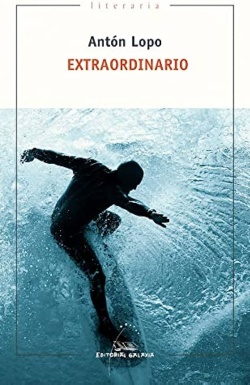
The fourth novel, Extraordinary, by one of Galicia’s most revered authors, Antón Lopo, is a 160-page, formally innovative exploration of masculinity, queerness, the body, and grotesqueness (à la Carson McCullers), clothed in a family drama about a man’s journey home, back into the heart of his emotional trauma.
The narrator, Óscar, a bisexual, middle-aged man and male escort, receives a call from his sister, Ana: their mother is in the hospital. She needs his help. She knows it’s too much to ask. Their mother is largely the reason he’s never come back home, after she sent him to a boarding school “that does good work on people like you,” when she heard a rumor he was dating a male classmate. It’s their mother who ridiculed and reviled him throughout his childhood, who never took his side when his older brother, Marcos, viciously tormented him, and it’s their mother who left him with such deep emotional scars that he still can’t bear to look at himself in a mirror decades later.
In view of their elder brother’s excuses, and Ana’s inability to handle all the shifts by their mother’s bedside on her own, Óscar clears his schedule, overwaters his plants, and packs a few days’ worth of clothes as he boards a train back to his (unnamed) small home city in the heart of Galicia.
Divided into ninety short sections ranging from a single paragraph to a few pages, the novel is light on its feet, never lingering too long in once place. Óscar shuttles between past and present, between his memories and his perceptions years later, as if he can’t bear to dwell in either place for long; he has to process things slowly, take the time to revisit a past he has repressed for so many years. Even his narration is characterized by short, staccato sentences and an obsession with detail [which comes in the form of extraneous annotations on his own narration, like this], in an apparent attempt to deflect emotion, to contemplate the world and his past as if they belong to someone else.
In the hospital, his mother oscillates between violent, morphine-induced fugue states, caustic lucidity, and childlike vulnerability between her surgeries. Meanwhile Óscar, unable to resist the pull of her dark gravity, ends up spending not days but weeks back home: sleeping in his childhood bedroom, reading through old diaries, arguing with inheritance-obsessed, alpha-male Marcos, reminiscing with Ana, exploring old haunts, and reuniting with family, friends, and old flings.
His past is littered with memories of being made to feel like a misfit. At school. At home. For his odd body, his peculiar personality. What would be viewed in most children as a quirk, or at worst a phase, made him a target for derision at home. The examples are innumerable, but one occupies a central place in his life: furious that he didn’t fit “right” into any of the suits he tried on ahead of his First Communion at age nine, his mother lugged him and his indifferent father to Santiago, the capital, to test Óscar for dwarfism. There’s nothing unusual about him, the doctor is pleased to say, except, well, the “extraordinary size of his genitals.” But before you groan, Lopo isn’t that kind of author.
No, if anything, this revelation marks the beginning of a stunningly tender, intimate portrayal of a young boy’s awakening sense of self, of his body, and of his own frustrated autonomy. Lopo is an unconventional writer, always seeking to push boundaries. But in this case, rather than break new ground, he takes a familiar genre (the family drama) and turns it on its head to explore his own aesthetic and thematic interests. Grotesqueness, bodies that place people on the margins of society, have always been at the fore of his writing, and for him, bodies are a political space as much as a personal one, just as personal stories can so often be political, just as Óscar’s story is about more than just him.
Without going into a deep interpretation, suffice it to say that this novel does so much subtle work in the interplay between earnestness and superficiality, beauty and grotesqueness, rural and urban, traditional (toxic) and “new” masculinity, queer and straight…I think it would fit nicely in a catalog with works like those of Annie Ernaux, in particular A Girl’s Story, with the way it so intimately, painfully recreates a time and place as it meanders its way towards the heart of a traumatic, formative experience. Lopo goes about it quite differently, and fictionally, but no less brilliantly or beautifully.
Synopsis © Jacob Rogers

 Portico of Galician Literature