
Synopsis
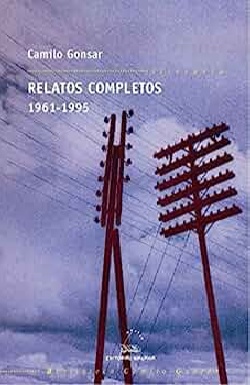
As well as publishing four novels, the most famous of which are Towards Times Square (1980) and Disaster (1983), Camilo Gonsar was admired for his skill at writing stories. He published three books of stories in his lifetime: Far from Us and Inside (1961), Cement and Other Scenes (1994) and Around the No (1995). These have been brought together in a volume entitled Collected Stories 1961-1995 (264 pages), which was published in the year 2008 by Editorial Galaxia, shortly before the author died.
In the first story of Far from Us and Inside, “Journey through the Night”, a Galician emigrant who has gone to work in London has been to have dinner with an English girl and her parents in Coulsdon. He has missed the last bus home. He tries the railway station, but there won’t be a train until six in the morning. He thinks about sheltering from the rain and snow under the roof of the station, but a station employee urges him to try hitching a ride instead and takes him to the nearest main road. He gets a lift to somewhere outside Croydon and a second lift to another town he doesn’t recognize, where a policeman helps him and hails a car that takes him to Clapham North, where he is finally able to catch a bus to Charing Cross and from there to walk home. Life is difficult without the right papers and he is considering getting a job as a butler in one of the Embassies or going to Finland or embarking again as a merchant seaman (which is how he met the English girl). He reaches the place where he shares a room with Vicente only to realize that he has left his key inside the house, the front doorbell doesn’t work and he doesn’t have any change to ring the landlord, Mr Strata. In the morning, he must set out again to look for work.
In “Ex Indigentia”, the author examines the case of a “cosmopolitan washer-up”, the kind of man who has become cosmopolitan not out of the abundance of his riches, but out of his need to find a job. He is the kind of man that is always on the move, he knows where he is leaving, but not where he is going to. The author compares this man, whom he names “X”, to some of the characters in George Orwell’s book Down and Out in Paris.
In “Echevarría”, Echevarría is a Basque man completing his military service in Santiago. He has difficulty speaking Spanish and is always singings songs in Basque, such as the one he composed for the love of his life, a girl who got married in Bolivia, or Brahms’ Lullaby, which he likes to sing to another recruit before going to bed. He and Anselmo go to visit a colleague, Ruibal, who has broken his thighbone and is in hospital. They cannot bear the cries and laments of their friend, who has only just been operated on, and go back to the city, where they get drunk in various bars and have difficulty returning to the barracks. Echevarría comes from a well-to-do family with factories in the Basque Country, but whenever he worked in one of them, he would get drunk with the workers and so now his family is happy to keep him at a distance. He wears slippers instead of shoes, when he gets a haircut, he has his head shaved so that he won’t have to visit the barber’s for a long while, and he never gets undressed before going to bed.
In “The Return”, Amadeo is a handsome man in his later years, already a grandfather, but with a tendency to drink. It is after nine, and he is walking home with Benigno and Ramiro. He keeps wanting to say something and trying to persuade the others to wait for him, but they prefer to talk about their own things and not to be late, their wives are waiting for them at home. Amadeo’s wife, Manuela, likes to complain; Amadeo thinks she has nothing to complain about. That day, he has seen a pretty girl. He may be old, but he can still discern a pretty girl. He calls Benigno over to tell him what it was he wanted to say, but as soon as he leans over to whisper it in his ear, he bursts out laughing. In “The Blind Man with the Coplas”, a blind man travels from Ponferrada to Monforte de Lemos and back, selling coplas that are a little out-of-date and also long Andalusian songs on paper, but nobody really wants to buy them. He reminisces about when he was younger, stealing peaches, a pretty girl he met during Carnival, the money he could have made if he had stayed to work in France. In “The Little Boy and the Cows”, a little boy is off school and goes to help his father in the fields. His father is cutting branches and loading them on to a cart. The boy has to keep using a goad to stop some cows chewing a young willow tree. He has always felt these cows to be like mothers to him, but realizes now that to them he is like a grown-up, not a child. This makes him pensive and uncommunicative for the rest of the day.
At the end of Far from Us and Inside are some “other, later pages”, comprising three short stories. In “Of Yesterday and Today”, which is divided into five parts, a woman is afraid to get off the bus to buy something from the chemist’s in case the bus leaves before she returns; in a dream, Pío Baroja’s brother wants to board a plane in Rome with two cows and is finally allowed to because the plane is considered Spanish territory; three young men from Madrid visit Galicia and are alarmed to discover the inhabitants there speak what sounds to them like Catalan; a young man is encouraged to read precisely those works of history and philosophy that were blacklisted in his schoolbooks; and Professor Rodrigues Lapa has suggested merging Galician with Portuguese in order to prevent the irrevocable disappearance of the former. In “Trump Card”, there have been bombs recently in Madrid, and a man is arrested for loitering. He explains he is from the same town as two Galician policemen and is allowed to go. He was about to use his trump card: namely that he was due to meet with two friends who are friends with two members of the Regime, but it’s lucky he doesn’t do this as it turns out they have been accused of planting the bombs. And in “Reading”, a father has picked his son up from school. They have stopped to drink something in a bar, but every time the boy asks for something, the father tells him to be quiet so he can read the football reports in the newspaper.
The three stories in Cement and Other Scenes, a volume of only sixty pages, were later incorporated into the book Around the No.
In the first story of Around the No, “Figures from Yesterday in Today’s Landscape”, a man and two women, whom the narrator takes to be siblings, old landowners whose lands are neglected and who are facing poverty, have gone to a café in the provincial capital. They are confronted by problems. First, which table to sit at so that they are in the shade? Then which side of the coffee cup to drink from so that they do not drink where most other customers have drunk from (the brother ends up drinking from the side opposite the handle)? Then it is time to leave so they can be assured of a good seat on the bus. Meanwhile, the narrator goes for a walk in the park, which used to be pleasant, but now the greenery of the landscape has been disfigured by concrete and there is a bloody syringe in a tree, like the one he imagines being stuck in the backs of the landowners. In “The Eternal Countryman”, the narrator follows the progress of a typical countryman dressed in a suit, with a stick and a noble bearing, a man of very few words who never asks questions, in the years following the Spanish Civil War: he is the last to leave the town when it is market day; he accompanies his granddaughter when she has to leave the village and take the feared public exams for those who wish to continue with their education after the age of ten, which of course she doesn’t pass; and finally he is a little lost in the new concrete jungle that springs up with adverts for courses in Kabbalah and Tarot. After that, the narrator doesn’t see him for a while – he only hopes better times are in store for the eternal countryman.
In “Cement”, a man is appalled by the barriers between people, people’s disregard for others, the ever-present pop music in public spaces like the railway station or on board a bus (which you cannot escape from), the lateness and discomfort of trains which would prefer to remain in the station, their natural home. Everything has been taken over by cement. And when a lame man tries to walk up a steep street to get to his car, a municipal policeman appears to fine him for parking his car illegally. In “Elegy for A Coutada”, the city represents the Fall, the village Paradise Lost. Eladio has inherited a large stone house in the country and wishes to devote himself to the farmer’s ascetic life, but in the end he and his family do not go.
In “The Demythologization of Antero Corga”, everybody in the town remembers Antero Corga, who was the life and soul of the party and would take groups hunting at night for an imaginary animal he called a cozorello. He later emigrated to Venezuela, but when he returns to the town one day – a returned emigrant with a Venezuelan accent – everyone suddenly chooses to forget he ever existed, and he only stays for a couple of days. In “Totum revolutum”, which is divided into eight parts, a man is surprised to enter a public lavatory in New York and to find cubicles full of men defecating with the door open; a Galician who thinks he has a good knowledge of English is disappointed to realize he doesn’t understand a word of what a native speaker is saying; two men take a stand against racism; the author does not agree with two of the prohibitions listed in Julian Barnes’ novel Flaubert’s Parrot – on the use of initials in place of names and on novels that are based on other novels; the author cannot understand people’s taste for Flaubert or for such an immature and predictable character as Madame Bovary; he is much more in favour of the characterization in Tolstoy’s novel Anna Karenina; the author thinks the teaching of philosophy in the past encouraged students to value bad philosophers over good ones; a returned emigrant is unable to thread together the “three rivers” of his life, which seem to him to have no connection between them: his early childhood in the village, when there were expansive fields of rye, his years in Venezuela, chauffeuring a lawyer, and his return to the village, where he now runs a grocery store.
In “Cat on a Uralite Roof”, Brandariz is a trained engineer who, owing to poor health, now works as a manager in an apartment block called the Caracas. He not only watches over who goes in and out of the building, he also fixes the heating, makes sure everything is working properly. But one day a cat turns up and roams around the building. When Brandariz finally manages to corner the cat, it stares at him with eyes of fire and he has to back off, just as the Doberman from one of the flats has done. The cat disappears, but soon reappears in the garage under the building. They reach some kind of entente cordiale, but when the cat then has kittens, Brandariz takes this as a personal affront and transports the five kittens to a clearing some distance away. Three of the kittens reappear the next day in the garage, so Brandariz is reduced to throwing them in the rubbish so they will be disposed of by the dustmen. He cannot get the cat, however, out of his mind and one day encounters it in the attic. He chases it out of the skylight and then closes the window so that the cat is confined to the roof. He waits a month and a half before opening the window again, knowing the cat has had nowhere to go. What he sees on opening the window again is enough to give him a heart attack, but we never find out what that was. We only learn that his friend, Mr Oia, has received a similar-looking cat from a cousin a short time before. In “Self-Interview”, a man interviews himself to give his opinion on Nationalism in Spain, which harks back to a Glorious Past, has no time for peripheral nationalisms and likes to emphasize how it is different from other Nations.
In “Of Trout and War”, the narrator goes fishing with two friends. One of them, M., is a returned emigrant from Venezuela and tells the story of how his father survived an assassination attempt at the start of the Spanish Civil War. He was shot, but not killed, and only feigned his own death so that the murderers would leave him alone. He managed to get back to his house and had to hide in a cave for a time. He never told his son, M., the reason he was taken to be killed by the Falangists; apparently, it was because he had belonged to a trade union. But M. worked out it was because one of the murderers had been falsely accused of killing a woman, M.’s father had hired a good lawyer at some expense to get him out of prison and the Murderer had promised to pay him back this money. In order to avoid settling this debt, he had ensured that M.’s father was included in the list of people to be killed. M. thinks his father never told him the real reason so that he wouldn’t entertain a desire for revenge, but when he finds out that the Murderer is staying nearby, he goes to the inn and waits outside all night. He doesn’t find him, but admits that if he had, he would have bashed his teeth in. In “Galicia”, a story that appears in English in the bilingual Anthology of Galician Literature 1981-2011 edited by Jonathan Dunne, a little girl has been sent by her mother to buy some sulphur from the town that is an hour’s walk away. When she asks – in Galician – the storeowner for a quarter peseta’s worth of sulphur, the storeowner haughtily explains – in Spanish – that he only sells sulphur by the peseta. At this point, a wealthy customer enters the store, and the girl uses this opportunity to beat a hasty retreat. Back at home, she is chastised by her mother for returning home empty-handed. It is now some years later, and the girl is a beautiful woman married to a wealthy Englishman. They drive up to the store in an expensive Jaguar, she gets out and – this time in English – asks for some sulphur. The storeowner cannot understand and thinks that perhaps she is asking for some toothpaste. He is very flustered. The woman says not to worry and lets out a slightly cruel, if golden, peal of laughter. When she leaves, the storeowner turns to discuss the situation with a local in Galician. And finally in “Kemp”, Kemp asks the narrator to come up with an absurd situation that could occur to them while they are drinking in a bar. The narrator suggests that a mist could enter the bar and swallow them up. Kemp finds this very funny. He then suggests that life itself, our own existence, can be seen to be as insubstantial as a dream. Kemp then moves to Oslo, where one day he disappears, as if swallowed up by a mist.
In Collected Stories 1961-1995, one is impressed by the author’s ability to tell a story, to create an atmosphere, to use simple, ordinary daily events to highlight the plight and complexity of human existence. Characters are often on the move, going from one place to another, and their concerns are basic ones: how to find a job, how to stop a cow chewing a willow tree, how to buy some sulphur, how to feign being dead. The endings to these stories are often unexplained: we never find out what Brandariz saw when he stuck his head out of the window, or whether the Galician emigrant in London got a job as a butler. The ending is left hanging in the air. Camilo Gonsar is one of few authors to be able to marry the traditional rural environment of Galicia with a more “cosmopolitan” surrounding in London or New York, to avoid the distinction between rural and urban, or traditional and modern, and to concentrate on human concerns at the heart of all existence. This makes Collected Stories 1961-1995 a timeless and satisfying read.
Synopsis © Jonathan Dunne

 Portico of Galician Literature