

Biography
Antonio M. Fraga is a highly successful writer in the Galician language who writes mainly young adult and children’s literature. He has won both the major young adult and children’s literature awards in Galicia, the Jules Verne for santoamaro (named after a beach in Coruña) and the Merlín for The Chestnut Seller of April. An industrial engineer by training, he has also published a young adult novel, Tartarus, about a girl in the Gwende community who strays into a Malluma suburb (this novel is available to read in English), The Scientific Bestiary of Anxos Nogueirosa, recipient of the María Victoria Moreno Award, and several adult novels including Dear H. P. Lovecraft, winner of the Galician Critics’ Prize, and Askja, a love story set in Iceland.
Synopsis
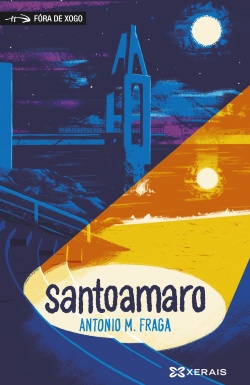
santoamaro (128 pages) is a young adult novel by Antonio M. Fraga and winner of the Jules Verne Award in 2020. It is named after a beach in Coruña, Santo Amaro, which in turn is named after a mythical figure who, like St Brendan in Ireland, set off in search of the earthly paradise. This took him and his fellows across the Atlantic Ocean in the direction of the setting sun. The beach in Coruña faces in the same direction. A group of friends has just finished school and, in their last summer together, before they all follow their own paths, they arrange to meet late on a Saturday night to swim in the sea and chat.
Sample
The curtain rises. The spotlights go on. A beach.
The Moon, almost full, tacks a silver thread onto the Atlantic’s cracked surface. White and yellow-footed gulls fly over the bay like letters in search of a recipient. Their high-pitched screams make almost as much of a racket as the sum of all the parties being held that night in the city at the end of the academic year.
So, the summer arrives, nocturnal and noisy. It brings with it a mélange of dust, sweat, and suncream for varnishing skins. A broth that has such a hypnotic aroma it makes you think winter may never have existed.
The summer promises long, extremely long days in which the viewpoint on the old crane will exchange static fishing rods for young people jumping into the sea, eager to show off their daring before the spectators sunbathing on the sand.
At the other end of the beach, the Sea Club’s esplanade will fill with towels and fathers and mothers who will offer their comrades a teatime sandwich. They will share the space with retirees, bronzed and satisfied, greeting each other with insults (sometimes pleasant, others not) or energetic slaps on the back.
But that will happen during the daytime. Now, in the early hours, the lights of Monte Alto and Durmideiras flank a stage that is completely dark, silent and impatient to receive a story. A happy story – or a sad one? It’ll be the summer who decides that.

 Portico of Galician Literature