
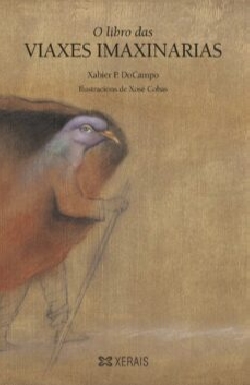
Synopsis
The Book of Imaginary Journeys (224 pages) comprises two travel journals written by a certain X.B.R., in the first of which the Traveller describes the cities and kingdoms he visits. This makes up thirty short texts. The second journal contains notes and drawings the Traveller jots down along the way, together with more intimate reflections. These drawings and reflections are interspersed between the more descriptive texts. The book is inspired by Italo Calvino’s novel Invisible Cities.
The book begins by stating that ‘All journeys are a return. Any traveller returns home the moment he sets foot outside the house. He has to come back in order to say what has happened, to turn the journey into a story’. The first place the Traveller goes to is Arimoi, where visitors are only allowed to stay for three days, otherwise they will be handed over to the Primate’s soldiers. In Arimoi, he is welcomed into the house of Quinto and Liceria and shown the kingdom’s greatest secret: it is built on top of a gold column that rests on the fulcrum of a glistening diamond. Arimoi was built by the hand of God in order to show the extent of his wisdom. This text is preceded by an incantation the Traveller must recite before setting out on his way. It is followed by a recipe for preparing millet with quail and trout.
Arama is a place where dust storms always threaten to rise into the air. The doors are adorned with different door knockers. If you knock on one, they will ask you what you want and then direct you to the only inn. Here, you will find the door ever so slightly ajar but, when you knock out of politeness, the echo resounds throughout Arama and all the doors open at once. Fortina is a woman who imagines Arama to be a musical city, but spends her time conducting choirs and orchestras only she is capable of hearing. Arodisi is a city built on the surface of a river, to which you gain access by crossing a bridge. You then have to be measured to make sure you’re the right size to be allowed in. The houses are built on stilts. Its inhabitants are afraid of the giants who live in the mountains because they have destroyed all the cities built on the banks of the river, which is why their city is built on the river itself, although none of them can claim to have seen the giants. Tigrio is a shipwright who dreams of sailing down the river to the sea.
Aruasi is famous for being the kingdom of the just. An old man tells the traveller that in this city parents will hand their own child over to the judge to be punished for a misdeed, but later an old woman affirms that parents will never hand their own child over to the judge, but will discipline him themselves, because the first thing is love. Agricio is a lean old man who appears on all the roads, offering travellers advice. He is much respected. The kingdom of Arode is divided into two capitals: one for the living, and one for the dead. In the dead city, bodies are laid out with books that record their deeds or misdeeds. The inhabitants of the living city strive to attain an honourable position in history, they are already concerned about how they will be remembered. A sign records the exploits of one king of Arode, Quinidius II. Amri is a city that was built under a cherry tree. All went well there until the inhabitants decided to stop the birds stealing cherries from the tree. They managed with nets and other devices to scare the birds off, but then the tree began to die and the city fell into ruin. Only one old man is left. The roads on which the Traveller walks are full of voices that break the silence, sometimes it is necessary to take the overgrown path on which the only voice is that of one’s doubts.
In Aibone, the only inhabitants are women and they live in the tops of trees that distance them from the stench of the bog. The women are said to live in absolute harmony with one another, although all the Traveller is able to ascertain is the sound of their song, of which he records an example. Adiebo is a place where all the houses – and all the inhabitants’ desires and dreams – are one and the same. Their desires come from above, from those in authority, they only live to carry them out. In this city, the Traveller hears the blacksmith’s music as he hammers on the cold metal. In Aimefue, a city built inside a forest, the trees move and have their own language. The Traveller drinks from a bowl in which is a water lily, a woman waiting for her love.
Aiza is a city where nobody ever sleeps. Some travellers are entranced by the beauty of its architecture and end up spending the night there, falling asleep and being sacrificed in the temple, the destiny of all who fall asleep. Efisio is a man who treasures the earth so much he would like to plough it with a pair of unicorns. Aivilo is built around a lake where those who have drowned and not been washed up in thirty days are carried by underground rivers. Their loved ones wait for them to appear and then take their bodies home with them. The Traveller meets one Rogato, who goes about the world collecting seven keys so he can recover a treasure in Arabia. Aiportue is reached by seven bridges: one for maidens who wish to fall in love; another where people go to hold Death up, so the person who was destined to die has time to escape the city; on another, people wait for the arrival of a child or women go to get pregnant; there is a fifth where sick people are healed; a sixth where the king returns from battle; and a seventh on which the dead are carried to the cemetery and all travellers must leave if they want to meet with good fortune. The Traveller is struck by the beauty of a woman in the rain, Alsira.
In Arualga, the city of mosaics, there are two chroniclers: one who chronicles the city’s exploits and successes; another who chronicles its shameful deeds and failures. The former events are recorded on blue mosaics, the latter on yellow mosaics mounted on the walls. The Traveller discovers the meaning of these mosaics through the help of his interpreter, Liberina. Amleda is a city built on a rotating platform. The platform is moved by the wheel of a watermill, which is powered by an underground river. This was the king’s ploy to make sure he could keep a constant eye on his enemies. Aigra is plagued by a monster that consumes people’s shadows. Its inhabitants have tried to locate the monster’s lair so that they can fill it with light and deprive the monster of its food. Otherwise, they will have to rely on the queen’s future daughter, who, it is said, will be able to control the climate and ensure permanently overcast skies, something the city’s inhabitants would rather avoid.
Aiznire is an island that used to be attached to the mainland, but its inhabitants preferred to be surrounded by the sea, even at the risk of wandering eternally over the waves. On the quay are ninety-five statues of Nereids. It is said that some of them are real and, if you say their name, they will take you down to their father’s house under the sea. Ainale is surrounded by two walls, which it is impossible to traverse except through a tiny crack and on all fours. Inside, all the houses are in ruins, except for the king’s marble palace, where a musical phrase can be heard being played on an organ. This phrase has been transcribed for the reader. Asiral is a city inhabited by people whose ancestors were birds. They live in houses like nests and chirp to one another. The Traveller enters the king’s palace and touches the arm of the king’s throne. He doesn’t realize two crimes are punishable by death in Asiral – touching the king’s throne and maltreating birds – but a local girl who knows how to speak his language defends him in court and gets him released on the grounds that maltreating a bird is obviously wrong, but touching the throne isn’t. The Traveller is expelled, together with his baggage.
The inhabitants of Adnilo have forgotten the past and are therefore incapable of recognizing the present. A mist protects the Traveller’s country. Three rivers crisscross the city of Ainorfo, bringing bread and carrying off filth. The waters of each are a different colour. The Traveller records a series of aphorisms. Aizapi is built on top of a mountain and has only one inhabitant, the king. To get there, the Traveller has to resist temptation and protect himself against the stench emanating from the city. Also, he must not enter the city, or he will never come out again. An inscription relates what the Traveller can take with him off the mountain.
The inhabitants of Aria are buried with the title of a book on their gravestone instead of their name. The Traveller includes a map of the cemetery, whose three main thoroughfares are Lyric, Epic and Dramatic. The queen of Ainoe had a mirror with three coatings of quicksilver. The first told her what she wanted to hear; the second conveyed the wishes and desires of her people; the third told her the truth. She preferred not to consult the third coating and, when the mirror broke (because it was so weighed down by untold truths), all the truths and royal secrets were scattered among her people. The Traveller records a series of proverbs. In Aipasue, there were three polished urns which the inhabitants thought might contain the secret to happiness. One day, Ecio entered the palace where they were kept, stole one and broke the seal. What the urn actually contained was the king’s pained expression. At this point, the whole city, made of bronze, sank to the bottom of the sea. The Traveller writes a letter to his absent lover in the hope that she will wait for him.
The currency in Aixodue is only valid for one year. This means people can only earn what they can use in a single year, they cannot save. No other coins are valid in Aixodue, so the Traveller must tell a story in order to pay for his lodging. In this story, a rich lady tells a lovesick servant if he truly loved her, he would die of love. The servant gladly dies, but the lady’s daughter is in love with the servant and also dies when she hears the news. The rich lady is the only one who cannot bring herself to die of a broken heart. The inhabitants of Anairo have it in their power to depose their king, who is removed to a quiet place and succeeded by one of his ministers. The Traveller speaks to a friend and hopes he will recognize him when he returns. The Traveller rushes past Añipse. Its inhabitants feed on human flesh, and he does not wish to give any indication of its whereabouts. The Traveller describes some of the traditions related to women in the places he has visited.
In Asiral, the ministers are obliged to wear a hangman’s noose around their neck. They will be hanged if they are found guilty of any injustice or corruption, although one woman says she has no recollection of this ever happening. It seems the noose acts as an effective deterrent. The Traveller gives a list of some of the people he has met along the way. Aiznari has been at war with its neighbours for three hundred years. Only the king and his generals want this war, the inhabitants just want to go fishing, but anything that would serve as a fishing rod is requisitioned as a spear. The Traveller gives a list of various salves and potions. The last place the Traveller visits before returning home is the city of Aisía, some of whose inhabitants hold their faces and emit a silent scream only the Traveller can hear and the other inhabitants ignore. This is the end of the narrative.
The Book of Imaginary Journeys is considered one of Xabier DoCampo’s most successful works. It was voted the best book of young adult literature in 2008 by both the Galician-Language Writers Association and the literary blog Fervenzas Literarias. It draws its inspiration from Italo Calvino’s famous novel Invisible Cities. Unlike Calvino’s novel, however, Xabier DoCampo’s text is accompanied by Xosé Cobas’ extraordinary colour illustrations in a handsome, large-format hardback. These illustrations were awarded the Isaac Díaz Pardo Prize for best illustrated book.
Synopsis © Jonathan Dunne

 Portico of Galician Literature