
Synopsis
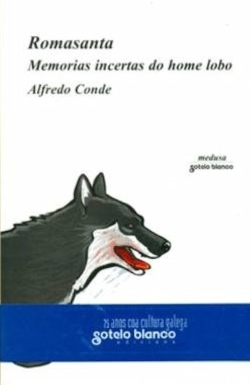
Romasanta: Uncertain Memoirs of the Galician Wolfman (158 pages) retells the story of Spain’s first documented serial killer, Manuel Blanco Romasanta, who had previously been portrayed as a travelling salesman who attacked his victims without being aware of what he was doing. Owing to a complicated court case and some scientific quackery, the defendant was eventually pardoned by Isabella II of Spain. Alfredo Conde, a descendant of one of the doctors involved in the case, chose to portray him as a merciless killer who was out to get rich in a book that was later made into a film, Romasanta: The Werewolf Hunt (2004).
In the first chapter, narrated in the first person singular, Manuel Blanco Romasanta is about to turn forty-three. These are his memoirs. He continues to work as a travelling salesman, which has enabled him to become rich. As a child, he was good-looking and drew people’s attention by the things that he used to make. The fact that people paid him attention, used to talk about him, gave him a thrill. He grew up in what could barely even be described as a small village, Regueiro, near Esgos, in the south-eastern Galician province of Ourense. He didn’t enjoy making things such as cattle prods and bird cages that other boys made, even though he did it well, because they didn’t attract people’s attention. He then learned to read in Spanish so that he would be able to leave the village and see the world. This also gave him pleasure because he knew that people would be talking about him behind his back. He learned to be a tailor, a cook and a taxidermist, taking pleasure in causing the animals pain before they died and in watching the light fade from their eyes. He served as an acolyte, sewed priestly clothes and even learned Latin, but the priest must have noticed his wayward inclinations because he didn’t encourage him to become a priest, so he chose to become a travelling salesman instead, purchasing fancy wares in Chaves, Portugal, and then selling them in the villages near where he lived. His main motive, however, was not to make a large profit, but to win the confidence of the women who invited him into their homes and bought his products. Despite his contempt for them, he acted like one of them, adopting their gestures and words, so they would treat him as one of them and offer him protection. He took advantage of the local men’s absence, although he felt sorry for the hard life that these men led as reapers in Castile. He preferred to avoid this sort of life and devoted himself to dissecting birds and slicing off human fat that was used by the Portuguese to make soap or by apothecaries to prepare their concoctions.
He has been examined by a doctor whose name he shall never forget, Don Vicente María Feijoo Montenegro y Arias, who claims that Romasanta always sets out to please, allows flashes of his personality so that people will see what really lies inside him and suffers from lycanthropy, the belief that he is a wolf and the need to behave accordingly.
In the second chapter, Romasanta has travelled to Castile in order to avoid suspicion where he lives and has adopted an alias, Antonio Gómez, but he bumps into three fellow Galicians who recognize him and denounce him to the mayor of Nombela in Toledo, accusing him of the death of several women. It is 2 July 1852. One of the men is Martín Prado, to whom Romasanta sold the handkerchief of a woman he had murdered. The handkerchief was recognized, which led to Romasanta being linked to the murder. The men are aware that he has been selling human fat at great profit for use in soap and ointments. On the way to Chaves in Portugal, Romasanta stayed with an attractive widow, Manuela Gómez, in the village of Rebordechao. He soon became intimate with the widow, whose sisters observed their conduct. Romasanta later discovered that Manuela and her sisters saw him as their route out of the village. Manuela began to accompany him on his travels, and in the end Romasanta offered to make her his partner. He was aware that what she wanted was to make enough money so that she could be independent of him. During this time, Romasanta suspended his dealings in human fat because he didn’t want Manuela to know about this side of his business. On a trip to Chaves, he took Manuela’s fourteen-year-old daughter, Petronila, along with him, but was aroused by the sight of her urinating behind a bush, killed her and had sex with her. He then extracted the fat from her body. On his return to Rebordechao, he invented some story about Manuela going to work as a housekeeper for a priest near Santander and taking her daughter with her. This news placated Manuela’s youngest sister, Barbara, for a while. He then went to meet Manuela on her return from the sale of some houses, killed her on the spot and proceeded to murder two other sisters and their children and to strip them of their fat. Barbara continued to seek news about her sisters, which forced Romasanta to falsify a letter.
In the third chapter, Romasanta has been arrested in Nombela and taken back to Galicia. The mayor of a local village, Laza, reports one of Manuela’s sisters and her son as missing. Romasanta is prepared to conduct the local officials to the place of their murder, since he knows the terrain and feels that this will give him a chance to escape. As the doctor identifies the sister’s leg bone, startling the others with his powers of analysis and filling Romasanta himself with a mixture of admiration and boredom, Romasanta remembers some of the other people he has murdered in the course of several years. Before his accusers, he confesses to committing a series of murders because of a curse laid on him by members of his family. He ate the flesh of his victims in the company of two other men who suffered from the same curse. He claims to suffer from the curse as a result of being the seventh of nine brothers. On one occasion, as he relates, he came across a large wolf in the wild, which was followed by a smaller wolf that winked at him. He felt the urge to take off his clothes, to wallow naked in the mud and to run with the wolves. When he came to a river, he recounts that he saw his own reflection, which was that of a wolf. He spent four or five days in the company of the wolves, which then regained their normal appearance, turning out to be the two men with whom he ate the flesh of his victims, Don Genaro and Antonio. They turned into wolves for days on end, during which they would roam the countryside, murdering their victims. He claims that when they regained their human form, they shed tears for their victims and regretted their actions, but the impulse to turn into a wolf was overwhelming. He stopped having these symptoms a few days before being arrested in Nombela. The judge is inclined to believe his testimony, but one of the civil guards, who has a peasant’s intuition, can see right through him. He even admits to the murder of two women who were actually killed by wolves in order to confuse and mislead his audience.
In the fourth chapter, Romasanta is almost lynched as he is transferred to the prison in Allariz. Among the onlookers is Barbara, Manuela’s sister, who sets about whipping up the crowd, accusing the men of cowardice for not attacking him. Romasanta realizes that his only defence is to convince public opinion that he really is a Wolfman. He is examined by six doctors, including the aforementioned Dr Feijoo, who are convinced that Romasanta is sane and in control of his actions. He realizes that he will stand or fall, live or die, depending on the quality of his performance. Public opinion is divided: people in the towns believe that Romasanta is afflicted by the curse of lycanthropy; others, that he suffers unimaginable pain on account of his misdeeds and so has convinced himself that he is afflicted by this curse; but the doctors, centred on the figure of Feijoo, maintain that he is an avaricious and ambitious man who kills only for profit. In the courthouse, Romasanta goes into gory details about how he killed his victims in order to appear more bestial than human, though he stops short of describing how he extracted and melted down the human fat. He tries to make his audience feel compassion not for the victims, but for him, their executioner, a psychological feat in his opinion. He realizes that the person whose opinion counts for the most is Dr Feijoo, since he wields influence over the members of the tribunal. Barbara remains fierce in her opposition to him. He receives moral support from his parish priest, who believes that only a curse could have reduced him to such a state.
In the fifth chapter, Romasanta realizes that he is likely to be garrotted for his crimes and that to avoid this he must introduce the seed of doubt, using the conduit of the journalists who are covering his case to convince public opinion not only in Galicia, but in the rest of Spain. He is sentenced to death by a court in Allariz in April 1853, and his case is then referred to a higher court in Coruña. Here, he is represented by a new lawyer, Manuel Rúa Figueroa, who understands very well the power of the press in swaying public opinion. Meanwhile, Romasanta sets out to behave like a wolf as convincingly as possible, so people will believe the story about a curse. His cause is taken up by the local Church and his parish priest, who pray for him and need to believe that his actions are caused by the Devil and the wolf is his most palpable manifestation. Barbara stands out as a fervent opponent, eager to exact revenge for the death of her sisters and nephews. She does not swallow the story about becoming a wolf and is convinced the Devil has better things to do than to concern himself with Romasanta. There is also a growing sense of confidence between the doctor, Feijoo Montenegro, and Barbara, whom he has been to visit in her house in Rebordechao. Barbara has been canvassing the local villages to convince the inhabitants that Romasanta is not a Wolfman, but a murderer who killed for profit. The villagers are turning against him, the doctors are vacillating, only the priests appear to want to stand up for him. There is a moral revolution taking place.
In the sixth chapter, the Crown Prosecutor presents his case against Romasanta. Barbara tries to stir up feelings against him, but Romasanta is convinced he will come out on top, the uncultured peasant who has succumbed to an ancestral curse rather than a murderer who sliced off human fat in order to sell it. He believes that his version of events is by far the more interesting. He portrays himself as a poor peasant who is in need of people’s sympathy. Everyone else is superior to him, a position that will permit them to take pity on him. A letter is sent to the court in Coruña by the Spanish consul in Algiers, who claims to have news of an experiment carried out by a professor of electro-biology, Professor Philips, who has managed through hypnosis to transform a normal human being into a savage wolf. Enclosed is a letter from Professor Philips himself, who urges the court not to condemn this man to death. He is convinced that Romasanta is suffering from a mental disorder called lycanthropy. The case has attracted the attention of the Queen of Spain, Isabella II, who is prepared to suspend the death sentence, should it be passed, in order for science to be able to examine the case and to avoid the death of an innocent victim. Romasanta celebrates their intervention, although he of course sides with the version of events put forward by the Crown Prosecutor – that he murdered his victims with aforethought and in order to make a profit.
In the seventh chapter, the court in Coruña revokes the death sentence and passes a life sentence instead. So Romasanta is not absolved of his crimes, his sentence is commuted. Romasanta feels vindicated – his story has been believed, the help of Professor Philips and Queen Isabella has borne fruit, the press has wielded its influence. But he is still due to spend the rest of his life in prison. His lawyer celebrates Romasanta’s triumph and views his client with a mixture of pride and indifference. Barbara is beside herself with rage and would have killed him on the spot, had she had the opportunity, which according to Romasanta makes them equals. Meanwhile, Romasanta can content himself with acting the part of the Wolfman, now that his story has been confirmed.
In the eighth and last chapter, there is an appeal. The prosecutor argues that Romasanta represents a terrifying threat for society, and the members of the court revoke their previous verdict. The lawyer appeals to Queen Isabella, and it is rumoured that she will grant a pardon. Meanwhile, Romasanta concludes his memoirs in his cell in Coruña prison. He vows to make all those who have played a part in the trial and conviction of the Wolfman of Allariz pay for their conduct.
This is an intriguing and convincing narrative by one of Galicia’s most talented contemporary writers. The author has chosen to present Romasanta not as an illiterate peasant who didn’t know what he was doing, but as a schemer who wilfully killed his victims in order to make a handsome profit and who then set about obtaining a pardon by claiming that he suffered from an ancestral curse, lycanthropy. All the segments of society have a role to play – the masses, who clamour for justice, but are swayed by opinion as expressed in the media; the doctors, who present contradictory evidence; the local priest, who is fervent in his support and in his belief that Romasanta suffers at the hands of the Devil. We also see how human nature can be degraded by ambition and a lack of forgiveness. This reflection on the life of Spain’s first documented serial killer and society’s reaction to his crimes and imprisonment has been made into a film, Romasanta: The Werewolf Hunt (2004), directed by Paco Plaza and starring Julian Sands, Elsa Pataky and John Sharian.
Synopsis © Jonathan Dunne

 Portico of Galician Literature