
Synopsis
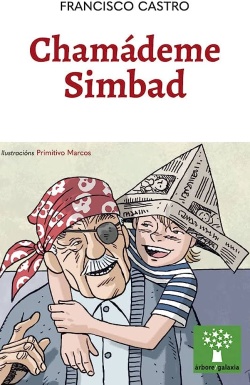
Call Me Sinbad (188 pages) is a children’s novel and is divided into twenty-two chapters and an afterword. The Galician edition has illustrations by Manel Cráneo and, in a later edition, by Primitivo Marcos.
Paulo is a ten-year-old boy who lives with his parents and his grandfather. His father spends all his time talking on his mobile phone. The record number of minutes he has spent talking without stopping is twenty-three. For this reason, he gets a red ear and doesn’t like it when his son points this out to him. On one occasion, his father went to the bathroom, and Paulo hid the phone under his bed. His father was furious and blamed his mother. Paulo’s grandfather found it all quite amusing. When Paulo’s father said Paulo behaved just like him, he answered that there was nothing strange in his behaviour – just ask his brother Bernardino. The trouble is, according to Paulo’s father and mother, this brother Bernardino doesn’t exist. Paulo’s father works until eight in the evening but, even when he comes home, he continues receiving work-related calls and barely pays the others any attention.
Paulo’s grandfather forgets that he has said something. He sometimes doesn’t recognize his own son and calls his daughter-in-law “madam”. The only person he doesn’t forget is Paulo, although he does call him Sinbad and ask him to approach on his ship and save him from these filibusters. When Paulo jumps on to the sofa – his ship – his grandfather laughs a lot, and his teeth fall out or, when he waves his arms about, he knocks things over. Then Paulo’s father tells Paulo to go and play with children his own age, but Paulo finds it much more fun to play with his grandfather. When he tells his grandfather he’s fun to play with and not like other people, his grandfather becomes serious and looks out the window at Bernardino’s house. Paulo has heard he has Alzheimer’s, but he doesn’t really understand what this is.
Paulo’s father says his grandfather goes through ‘difficult periods’. Paulo’s mother finds this hard to deal with, such as when he sits in front of the telly when it’s switched off, wanders about the house, gets up at night and turns the telly on loud, empties the fridge and spills the contents on the floor, or shouts at himself in the mirror. Paulo asks his father about the illness. He says people suffering from Alzheimer’s sometimes don’t remember things or behave strangely. Sometimes they behave like children. When Paulo’s mother goes out, then Paulo and his grandfather play at being Sinbad and the Captain of the Seven Seas (Paulo wonders who is captain of the other three seas on the planet). Paulo’s grandfather asks to be rescued, or they hide things in the house, which they call treasures. Everything is fine until one Sunday in February when they wake up and Paulo’s grandfather is no longer there.
Paulo’s parents inform the police that his grandfather is missing and go out to look for him. Paulo stays behind – his father says he’s too young to go searching the streets – and spends the day with his best friend, María, a girl who lives in the flat downstairs. He feels very sad when his parents return at the end of the day and still haven’t found him. He can’t understand why he would disappear like this. His grandfather’s disappearance occurs two weeks before Carnival, when Paulo plans to dress up as Sinbad, with a turban and a scimitar, but when the day arrives, he doesn’t feel like it. His mother asks his father to talk to him because he’s behaving strangely (who wouldn’t if their grandfather had disappeared?). Paulo asks his father to tell him his grandfather’s favourite story, Sinbad the Sailor, but his father, who does his best to ignore some calls on his mobile phone, gets some of the details wrong and says he can’t waste time telling him a story he’s already heard a hundred times, he has more important things to do, he has responsibilities. Paulo becomes angry with him because he never spends enough time with him, he always has work to do, and in the end he dresses up as Sinbad to attend Carnival and do battle against some filibusters outside.
A month later, the police give up their search, and Paulo tries to carry on as normal. One day, he is playing football outside with María and her three-year-old brother, Xavier, when the postman arrives with a letter for Sinbad from the Captain of the Seven Seas. Paulo is so surprised he lets in a goal by Xavier, even though the boy can’t play football. He rushes upstairs to open the letter in the privacy of the sitting room. In it, his grandfather asks what a Captain of the Seven Seas would do if people were trying to sink his ship – he would escape. Life is an adventure, and there are filibusters everywhere, even on board one’s own ship. He tells Paulo to search for him in the Pirate’s Tavern and encloses a tiny key. Paulo searches for ‘Pirate’s Tavern’ in the telephone directory and can’t imagine what such a tiny key could be for. Over lunch, he asks his parents if they’ve heard of the Pirate’s Tavern (without telling them about the letter). His mother drops her glass on the floor, and his father almost chokes on his spaghetti. They are obviously both very nervous. His father claims that this place does not exist and says he can’t eat any more, he’s going out. His mother says Paulo is not to blame for what has happened and urges him to finish his spaghetti.
After lunch, when his father has returned to the office, his mother enters his grandfather’s room to dust his books. She is dusting one, very large book – which turns out to be Sinbad the Sailor – when Paulo notices a small, rectangular box behind it. He surreptitiously takes the box out of his grandfather’s room, runs down the stairs of his block and inserts the tiny key his grandfather has sent him with the letter. It opens at the first attempt.
Inside the box are lots and lots of photos and papers. The photos are black and white and show various men in caps and hats eating and drinking in a bar. Very often, next to Paulo’s grandfather, there is another man who looks almost identical to him. On the back of the photos, his grandfather has written ‘Bernardino and me at the Pirate’s Tavern’. The papers, a type of onion skin, are in Paulo’s grandfather’s handwriting and are all addressed to Bernardino (though Paulo can’t work out why they haven’t been sent). They talk about life at home, about a grandson called Sinbad (which Paulo deduces is him!), about how kind Paulo’s mother is to him, but they never mention his father. In the last letter, he says he has heard Paulo’s parents talking about putting him in an old people’s home and how he’s not going to let them sink his ship or separate him from his grandson. As Paulo is putting the box back in his grandfather’s room, a business card falls out of the large book in front of it, with the name and address of the Pirate’s Tavern!
Over dinner, Paulo’s parents ask him if he had a good afternoon playing with his friends. Paulo confesses that he wasn’t playing with his friends, he was reading his grandfather’s letters to his brother Bernardino. When his parents ask him what letters he’s talking about, he goes to his grandfather’s room, retrieves the box and brings the letters to the kitchen for his father to read. After his father has read the letters, Paulo confronts them about the old people’s home. His parents confess that they were planning to send him to a home where he could be looked after properly, but Paulo says that’s a way of getting rid of old people until they are dead, it’s not something you would do to children who behave strangely or badly, so why would you do it with an old person? His own teacher at school looks after her mother at home, even though it’s difficult for her. Paulo also asks about his great-uncle Bernardino. His father says that, ever since his grandfather came to live with them, they haven’t seen or heard from Bernardino, who used to own the bar the Pirate’s Tavern, but the bar closed many years ago and Bernardino went back to sea on board a ship in Asia. Paulo is allowed to watch television all evening, while his mother berates his father in the kitchen for discussing the idea of an old people’s home in front of Paulo’s grandfather. He may be ill, but he’s not stupid, she says. In the shower that evening, Paulo takes a momentous decision.
The next day, he claims he’s going to play outside with María (even though his mother knows that on Sunday mornings María goes cycling with her father). His parents say OK, and Paulo goes downstairs to the bar at the bottom of their building, where he calls for a taxi to take him to the street where the Pirate’s Tavern is, in the old quarter. The taxi-driver drops him off at the start of the pedestrian zone, telling Paulo that the bar is just a little further down and certainly hasn’t closed. It’s still open and serves a very delicious dish of octopus at lunchtime. Paulo wanders down the deserted street, wondering where all the people can have got to, reaches a bar with no sign and enters. He is greeted by an enormous man who emerges from the kitchen. When he asks if this is the Pirate’s Tavern, he hears a shout of glee coming from the kitchen, ‘Sinbad!’
It turns out it was Bernardino who sent Paulo the letter, so he would find the bar and locate his grandfather. His grandfather is absolutely happy that Sinbad has come to rescue him, just as he thought he would. Paulo informs Bernardino that the reason his grandfather escaped was that his parents wanted to put him in an old people’s home. He then asks Bernardino why he never paid them a visit in all this time, but Bernardino says this is a question Paulo’s father will have to answer. Paulo’s grandfather starts to remember all the times his elder brother, Bernardino, saved his skin when they were children. Then, abruptly, he asks him to tell Paulo what happened with his father, but Bernardino refuses to talk badly about anyone and says his father will have to tell him himself. When Bernardino asks whether Paulo would like him to call his parents to tell them where he is, Paulo says no – he has left a note in his grandfather’s box and is sure his mother will find it, telling them where he has gone.
A moment later, a taxi arrives with Paulo’s parents, who rush into the bar to find Paulo with his grandfather and Bernardino. Paulo’s father accuses Bernardino of kidnapping his grandfather and threatens to call the police, but Paulo shouts at them in a loud voice and orders them to sit down and keep quiet. They are going to discuss this like grown-up people. When Paulo’s grandmother died, Paulo’s grandfather sold his flat, he didn’t want to live with so many memories, but it wasn’t clear whether he should live with his son, Paulo’s father, or with his brother, Bernardino. For a while, he did both – that was until Paulo was born, and then Paulo’s grandfather told Bernardino that he wanted to live all the time with his grandson and to watch him grow up, so Bernardino pretended that he was going to close the bar and return to sea, so Paulo’s father, who was worried about his work and his chances of promotion, would have no choice but to take care of his father. Paulo then promises his own father, when he is old and can’t do things for himself, he will look after him.
In the end, Paulo’s grandfather continues to live with them, but spends the day at a Day Centre where he can be looked after and do memory exercises. Bernardino closes the bar – he’s had enough of serving wine and octopus – and spends the evenings playing dominoes with Paulo’s grandfather and talking to him about their past. And Paulo’s father decides to spend more time with his family and even rejects an offer of promotion. He now turns off his mobile phone when he gets home in the evening.
This is a charming and humorous account of the life of a family, one of whose members is suffering from Alzheimer’s. It is also a serious look at some of the issues involved, at the sacrifices required and the importance of reaching a compromise. Paulo is only a ten-year-old boy, but in some situations he shows himself to be a lot more mature than the adults who surround him. He shows genuine affection and a willingness to make the situation work. His parents also display an ability to adapt to the circumstances, and in the end a compromise is reached which everyone can live with. Call Me Sinbad was included in the 2012 IBBY Honour List and was also awarded the Sarmiento Prize given each year by Galician schoolchildren to their favourite book.
Synopsis © Jonathan Dunne

 Portico of Galician Literature