
Synopsis
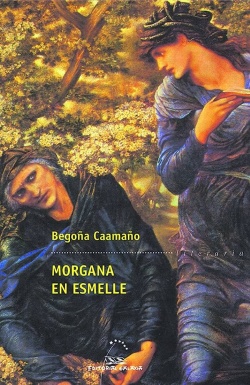
Four sources contribute to make up the narrative of Morgana in Esmelle (220 pages). They are the memoirs of Philip of Amancia, who was Merlin’s servant in his childhood years; the Chronicles of Avalon, a more objective source; Merlin’s own conscience; and the voice of Morgana, or Morgan le Fay, herself. Esmelle is a forest in the land of Miranda, in the province of Lugo, Galicia. This setting is taken from an earlier Galician novel centred on the Arthurian legend: Merlin and Company by Álvaro Cunqueiro.
The text starts with the memoirs of Philip of Amancia, Merlin’s pageboy. Merlin is now asleep or dead, Philip cannot be sure. He has merged with an oak tree and doesn’t move, or so at least the pageboy thinks. He remembers one stormy night many years before when Merlin, Lady Guinevere and the occupants of the house in Miranda were all at home and he saw through the window the arrival of a woman with black hair and white skin, who, despite the rain, didn’t seem to be wet. Merlin, sitting in front of the fire, was aware of her arrival, the dogs too seemed to want to welcome the visitor, and Merlin asked Philip to open the door. But the door opened by itself, and the woman, Morgana or Morgan le Fay, King Arthur’s supernatural elder sister, entered. Guinevere wasn’t pleased to see her – wasn’t it enough with all the trouble she had caused? But Merlin took the woman upstairs, where they talked for several hours.
In the second chapter, from the Chronicles of Avalon, Gorlois, the Duke of Cornwall, returns from battle in order to bed his wife, Lady Igrayne, but on the way he uncharacteristically ignores his little daughter, Morgana. When he embraces his wife outside the castle, Morgana discerns the shadow of a dragon. At first, she is confused, but then she becomes angry. Igrayne becomes pregnant. She is convinced that the child is her husband’s. The next day, the soldiers return with the body of Gorlois, saying he fell in battle the day before, but a thick, white mist prevented them from recovering the body until later that night. Igrayne says this cannot be true, she slept with her lord and master only the previous afternoon. Seven months later, once her pregnancy is well advanced, Uther Pendragon, her husband’s victor, comes to claim the castle of Tintagel, its lands and properties, but tells Igrayne that she may stay and asks her to marry him. Igrayne is offended, even more so when Uther tells her that the child in her womb is actually his. Merlin advises Igrayne to listen to him.
In the third chapter, taken from Merlin’s own conscience, Merlin remembers how, when Uther proceeded to relate not only details of Igrayne’s nakedness (these, however, were known to everybody since she used often to bathe or greet her husband naked), but also details of her lovemaking, Igrayne fainted and, when she came to, she gazed at Merlin, realizing that he was the cause of this deception, asking with her look why he should choose her womb in order to further his intentions. A few days later, Arthur was born. Igrayne agreed to marry Uther, but was now a shadow of her former self. It was Morgana who proceeded to care for her mother and half-brother, but without hiding her contempt for the figure of the wizard. In the Chronicles of Avalon, it will soon be Arthur’s seventh birthday and Merlin is planning to ask Uther for the boy, as was promised. The Druids’ Council on Avalon, under the leadership of Igrayne’s sister Vivian, decides it is time to act. They cannot leave Merlin’s actions unchallenged. In Philip of Amancia’s memoirs, Merlin is called to resolve a difficulty elsewhere and asks Philip to keep Morgana occupied while he is away and in particular to avoid the possibility of a confrontation between Morgana and Guinevere. Morgana and Philip have a highly entertaining day but, on their return, Philip is so hungry he leaves Morgana alone with Guinevere. Morgana makes fun of a tapestry Guinevere is weaving, showing the adulterous love between Tristan and Isolde, and provokes Guinevere’s anger.
In the Chronicles, Vivian appeals to Igrayne for her help, but Igrayne is already defeated. Vivian then tries to seduce Arthur with tales of Avalon and he expresses his wish to visit the island, but Merlin proceeds to tell Arthur that he will become a great king who will unite Britain and lead it to untold heights. Arthur swears his allegiance to Merlin, and it seems Vivian has lost the first round. She prepares to return to Avalon, but receives a visit from Merlin, who suggests they work together. Vivian rejects this advance from the man who was once her lover.
Merlin remembers how the Celts fought against the Roman invasion by taking to the hills and attacking them at night, how they learned some of the Druids’ magic arts, how a group of Druids withdrew to the island of Avalon to continue their quest for knowledge, and how Merlin set out to get to know the villages and peoples of Brittany in France, where he met an old man who suggested he visit Avalon, something Merlin had long wanted to do, but was afraid to. The old man gave him a necklace which, he said, would open the doors of Avalon to him. On his return to Cornwall, he set out for the island. There, because of his connection to the old man and the necklace he had been given, Merlin was welcomed without any further questions. He was lodged in a building with other children and started to receive lessons. He also established a firm friendship with a girl seven years younger than him, Vivian, with whom he shared games and knowledge. At one point, Vivian came to sleep in his bed and, for the next two years, they would sleep together, Vivian’s presence giving Merlin the calm he needed to sleep peacefully. The only difference between them was in their attitude towards knowledge, home-grown and distant legends, which Merlin would receive with great reverence, whereas Vivian would joke around, laugh at the legends sometimes (such as the idea from the Book of Genesis that a woman was formed from man’s rib and therefore somehow subservient to him) and want to share her knowledge with all those around her.
In the Chronicles, Merlin attempts to persuade Vivian that, after the collapse of the Roman Empire, at a time when all the tribes are trying to force themselves on each other, the best thing to do is to ally Britain with the new religion of Christianity. Vivian rejects this suggestion in favour of a republic in which people are free to acquire knowledge and to base their decisions on learning and culture. The two who were once so close agree to differ. Merlin leaves the room and Vivian discovers Morgana, who asks to be taken to Avalon in Arthur’s place. There, away from her hatred of her father’s usurper and her distrust of Merlin, Morgana is able to grow in knowledge and wisdom. She doesn’t see her half-brother Arthur, whom she loves dearly and whom she has helped to raise, for another seventeen years, when she is summoned to the court at Camelot for his wedding. In Philip of Amancia’s memoirs, everyone at the house in Miranda is enchanted with the new visitor, Morgana. Philip enjoys the games they play; the serving girl, Manoeliña, is grateful for some new shoes that Morgana gives her, which are much lighter and more graceful than the wooden clogs she normally wears; the farmhand, Xosé, is impressed by the way Morgana has with animals, including Merlin’s horse, Turpin. But Philip is disturbed by the unease Morgana’s presence seems to cause both in Guinevere, who avoids sitting at the same table as her, and in Merlin, who after hours spent shut up in his room with her, always comes out looking tired and weary.
In the Chronicles, Morgana attends Arthur’s wedding to Guinevere at Camelot. She arrives, looking a little out of place, and Guinevere insists that she dress and behave herself like a proper member of the court. She is the king’s sister, and he has struggled to unite Britain and to repel the Saxon threat. Guinevere doesn’t want Morgana spoiling it all with her appearance. On the morning of the wedding, Arthur and Morgana, who are overjoyed to see each other again, go off riding together. Merlin is worried at their absence. Arthur’s marriage to Guinevere, a devout Christian princess, is the final stage in his plan to make Arthur undisputed king of Britain. He is relieved when they return. During the wedding, he seems anxious in case someone should arrive to put a spanner in the works, but this doesn’t happen. Meanwhile, Morgana notices a melancholy knight who can’t keep his eyes off Guinevere. The person Merlin was afraid, and yet hoped, might turn up was Vivian. The wizard remembers how Vivian left the island of Avalon for several years to gain experience of the world and returned a fully grown woman. He was fearfully jealous of her when she flirted with other men, but soon they came together, became lovers, and shared a common opinion: that what Britain needed was to become a Celtic republic without feudal lords and vassals, in which everybody was free to acquire knowledge. However, at the age of 28, Merlin visits the mainland and decides that what Britain really needs is a strong king to defend the people from foreign invaders. He doesn’t return to Avalon because he knows he will succumb to Vivian again, and the wedding of Arthur and Guinevere is the culmination of his plans, but leaves him feeling empty.
In the Chronicles, Arthur is aware of the pure love that exists between Guinevere and Lancelot, and is unhappy in his marriage. His only solace is to be in the company of his half-sister, Morgana. When he falls ill, it is Morgana who cares for him. The court mistakenly believes that Lancelot is in love with Morgana, and Arthur is opposed because he hopes to gain an alliance by marrying Morgana off to some distant king. However, one morning, Guinevere discovers Arthur and Morgana in bed together, and the whole court witnesses this event, which Merlin blames on Morgana, claiming she has bewitched the king. Morgana leaves, pregnant with Mordred, and Arthur goes off in search of the Holy Grail in order to expiate his sin. In Philip of Amancia’s memoirs, Merlin is called to visit an old friend in Santiago de Compostela and leaves the two women, Guinevere and Morgana, alone. When he comes back, he is surprised to find that the two women are conversing pleasantly, sharing secrets and laughing in each other’s ear. Philip learns from Manoeliña that, as soon as Merlin had left, Morgana had gone into Guinevere’s bedroom, shut the door, and the two of them had spent most of the afternoon in tears. Now it seems they’ve reached an understanding, and the first thing they do is set about unstitching the tapestry Guinevere has so laboriously been weaving. She has her own beautiful and sad story to tell, they affirm. Merlin is afraid that Guinevere will look at him with the same resentment as Igrayne and Morgana, whose lives he disrupted with his scheming. The same is true of Guinevere. He made sure that her mother gave birth to a girl and used a serving woman to make sure that she was raised in the Christian faith. He persuaded her to marry Arthur so that she could convert the people of his kingdom to Christianity. But he wasn’t careful enough to watch over them after their marriage and to prevent Arthur falling into the arms of Morgana as a result of his unhappiness. To a certain extent, Merlin has tried to make up for his scheming, now that Arthur is dead, by bringing Guinevere to the forest of Esmelle and giving her a pleasant existence. Everything was fine until Morgana arrived.
The final chapter is in the voice of Morgana herself. She recognizes that she wasn’t interested in either of the visions that Merlin and Vivian had for Britain. She was interested in the only country that was her own: that of her family. And in Arthur, whom she had initially planned to drown as the fruit of a union that had taken away her father and ruined her mother, she had found the eyes of her mother, her real mother. That is what had caused her to start to love him. Both of them had lost their childhood thanks to the machinations of Merlin. They had tried to recover their childhood during their lovemaking, and Morgana’s only regret is that they didn’t stand by their decision, resist Merlin and the assembled court, remain together, travel far away. Morgana finds Merlin to be very different, more humble, more generous, in his hideaway in Miranda, Galicia, and she realizes that at some point we all have to face up to the consequences of our actions.
Morgana in Esmelle is a new treatment of the Arthurian legend in the context of Galicia, drawing on a setting from Álvaro Cunqueiro’s novel Merlin and Company, in which the famous wizard has retired to the Galician countryside. It is a very effective and well written recreation of the myth, in which different voices are heard – Morgana, Merlin and the loyal pageboy Philip of Amancia. The novel was widely celebrated when it came out in 2012 and constitutes a welcome addition to the corpus of Arthurian literature. It received the prizes for fiction of the Galician Publishers’ and the Galician-Language Writers’ Associations, the Spanish Critics’ Prize and the Losada Diéguez Prize for literary creation.
Synopsis © Jonathan Dunne

 Portico of Galician Literature