
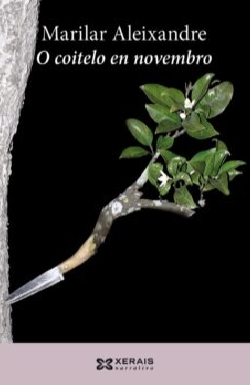
Synopsis
The Knife in November (272 pages) is described by the Galician publisher as a novel, but it is really a collection of interconnected stories along the lines of Ovid’s Metamorphoses or the One Thousand and One Nights. Many of the stories are set during the time of Franco’s dictatorship and detail events from murder to fishing to getting caught in a snow storm. The result is a text that boasts a fluent narrative and evocative references.
In ‘Death in the Chest’, Román accompanies his young uncle Marcos into the mountains of Lugo province. They are hunting for a wild boar that has caused some damage locally, but Román also knows that this is where Marcos goes to help the resistance fighters under Franco’s regime. They follow the scent of the boar but, once they’re deep inside its territory, the wind changes direction and they are lost. They wander for hours and end up at the house of a young woman called Dora, whom Román understands to be Marcos’ sweetheart. Marcos has obviously been there before. Dora has two brothers, one of whom, Ramiro, has a large knife and rude features. They sleep in a room with a large chest at the foot of the bed. One night, they open the chest, only to discover the corpse of an old woman dressed in black, with one eye open, staring at them. It turns out to be the corpse of Dora’s grandmother, who died recently and they are waiting to bury. Román regrets he does not have the same effect on Dora as Marcos does. After the snow storm, they leave. Several months later, Marcos is found dead in the mountains, either from the tusks of a boar or the bayonets of the Civil Guard. Román begins to take food to the resistance fighters in Marcos’ place and discovers that Dora’s brother Ramiro is one of them. He then receives a message from Dora, who hands him Marcos’ old shotgun, but is unable to commit to a relationship.
In ‘Alf Layla wa-Layla: 1 Resol’, a doctoral student called Mila, who has previously studied the relation between the narrative techniques of Ovid’s Metamorphoses and the One Thousand and One Nights, is in a second-hand bookshop when she discovers old copies of a Galician literary magazine, Resol, and among them fragments of the stories that make up The Knife in November. She buys the copies and takes them home. In one of these stories, ‘Lawless Mills’, a medical student in Santiago recalls the time he was invited to witness the dissection of a young woman’s body and later tells the story to a group of people around a fire. Two lovers planned to kill the young woman, who was a rich widow. The man pretended he was in love with her and eventually persuaded her to marry him, despite her family’s concerns. For a time, everything went well, he worked in the mill, grinding flour, but one day the wife turned up dead at home, having been stabbed in the heart. The miller was arrested and charged with her murder, but the death penalty was commuted to life imprisonment. It turns out that one of those listening to the story is the man’s mother. She asks the medical student to help her write to him in prison and corrects him on the colour of his eyes, which were not green, as he said, but black.
In ‘Alf Layla wa-Layla: 2 Three Leaves of Rue and One Green Garlic’, the doctoral student Mila looks at whether a book by Luís Seoane translated into Spanish, Three Leaves of Rue and One Green Garlic, ever had a Galician original, or whether the stories were first written in Spanish. This is connected to the identity of narrators and whether it matters that the originals of some stories are never found. In ‘Early Morning Impostures’, a young woman loses her virginity on the same night that her brother is arrested for distributing Communist pamphlets. In ‘Under the Trout’s Skin’, a grandfather explains to his granddaughter how to catch trout, how you have to get under the trout’s skin, understand the way it thinks. They are fishing one day when there is a loud bang. A poacher has used carbide to cause an explosion and kill several trout in one go, but they are not to sell, rather to feed his family. The grandfather, having punched him on the nose, lends him his handkerchief and gives him a wad of notes to help him out. In ‘Karl and Charles in The Red Lion’, Charles Darwin goes to visit Karl Marx in The Red Lion pub in London, where he is staying. They both lament the premature deaths of their children, Annie and Edgar, and ask what there is to live for if not to develop their own ideas and publish books that are later banned. In ‘Alf Layla wa-Layla: 3 Tell in Order to Live’, Mila wonders whether the gender of the narrative voice reflects that of the narrator and examines the experiences of Galician editors in Argentina. In ‘The Knife in November’, the death of an old dictator is compared to the death while young of those fighting for freedom. In ‘From Lavacolla’, a prisoner who is forced to help build Lavacolla airport in Santiago de Compostela writes a postcard to his sister, asking for socks, espadrilles, soap, sulphur ointment (for scabies) and a pencil. Not food, since he claims they have enough. In ‘The Names of Those Who Passed the Rio Negro’, the narrator remembers the names of those who died in exile, having passed the Rio Negro. In ‘In Disagreement’, a priest refuses to enter heaven if they don’t let a friend of his, who fought alongside him, enter with him.
In ‘Storage of Absences’, a lone fugitive in the mountains finds it difficult to believe only a few months before the Republicans won the elections, he was hunting for cormorant eggs on Ons Island and kissing his sweetheart, Melania. He hears of the death of Don Didio, a Republican, and swears to take a sprig of gorse to the mouth of hell on Ons Island where the cormorants have their nests. In ‘Alf Layla wa-Layla: 4 Home á Auga’, Mila continues investigating the authorship of the stories reproduced in the book. She has come across two initials, A. M., and wonders who they belong to. She also continues investigating the presence of Galician publishers in Argentina after the Spanish Civil War, among them Home á Auga (Man in the Water). In ‘Lists’, the author gives lists of payments, births and reading. In ‘Spiral of Ravings’, two acrobats make love in front of the mirror, the man’s sex is compared to a sharp knife or a word, sex is the price of staying alive. In ‘Shaken’, creatures in a reed-bed try to keep moving so they don’t lose hope. In ‘I Was Hunger’, a mother doesn’t have enough milk to keep her young daughter and son alive. The son, Cosme, dies. The daughter, Saludina, drinks what milk is left in her mother’s breast, mixed with blood and tears. In ‘Cervantes Six’, we read the history of the bookshop where the narrator is standing and how a widow was evicted, her son arrested for distributing pamphlets. The narrator is confused when her own name appears in the story. In ‘Alf Layla wa-Layla: 5 Furtive Portraits’, Mila continues to question the authorship of the stories, and sees her own initials, M. D., at the end of a story. In ‘Misplaced Words’, the narrator rescues words that have been abandoned or neglected and recovers them for use in a story or poem. In ‘The Netmaker’, Penelope weaves a net at night, as her grandmother taught her, and uses it to snare Odysseus and free herself of having to wait for him. In ‘Stored Names’, the narrator wonders why people bother to keep names. In ‘Turn to Wood with Daphne’, Apollo, unable to overcome his love for Daphne, turns to wood so he can be with the laurel tree. In ‘The Salter of Pork’, Dulcinea, Aldonza Lorenzo, is a lady of stature, not a salter of pork. After she rescues Cervantes and Don Quixote in a storm, Don Quixote returns a mule and the two of them become lovers. In ‘Ferocious in the Metro’, a family in Madrid during the Spanish Civil War seeks shelter in the metro whenever there is a bombing raid. Their dog, Ferocious, goes with them. The family suffers from hunger. One day, the father goes missing. He was caught outside during a raid and buried under bodies in a trench. His family assumes he is dead, but on the second day he returns and, to celebrate this, the mother prepares a paella with rabbit meat, only that the children discover the tail of their dog, Ferocious, in the bin.
In ‘Alf Layla wa-Layla: 6 The Hidden Mermaid’, Mila is on the trail of Aleksandra Mairal, whom she understands to be the author behind the initials A. M. We read one of her texts, ‘Joan of Arc Delivers an Apostasy Form’, in which Joan of Arc protests against the treatment she received and wishes to be considered an apostate. In ‘Flesh of a Mermaid’, the narrator, a biologist, meets the Little Mermaid from Hans Christian Andersen’s story, who claims she never agreed to exchange her voice for legs and mermaids are perfectly capable of making love with humans. In ‘Noose’, a novice waits for the morning before hanging herself in her cell. In ‘Vigo at the Winter Solstice’, the authorities of a city decide to expel all non-inhabitants such as beggars, buskers and street vendors. At the same time, water is discovered on the dark side of the moon, which in winter turns to ice. The city donates five pairs of skates to the non-inhabitants so they can be pioneers on the moon, but the non-inhabitants refuse unless all their children are given skates. In the end, the authorities allow the non-inhabitants to stay. In ‘Orphans’, a houseman, Manuel, attends a birth in Santiago. The mother is only fifteen and has been raped by her uncle. The child is given up for adoption. When Manuel starts a medical practice in a town in Galicia, he is summoned by the richest man, Don Ubaldo, who is concerned because his wife, Madalena, has not fallen pregnant. Manuel recognizes the girl who gave birth, so he knows the wife is not to blame. Nor is Don Ubaldo, since it appears he has fathered a child in town. Don Ubaldo sends his wife to a spa, where Manuel finds her and they make love. Madalena falls pregnant and Don Ubaldo congratulates himself.
In ‘Staphylococcus aureus’, there is an outbreak of the bacterium Staphylococcus aureus in a canning factory. The factory will have to close down. Meanwhile, one of the workers, Áurea, who has a similar name to the bacterium and dreams of becoming a schoolteacher, begins a relationship with the man in charge of sanitary control. In ‘Alf Layla wa-Layla: 7 You Who Write to Me’, Mila receives some recordings by Aleksandra Mairal. In ‘Little Red Speech’, Little Red Riding Hood and the wolf have become friends. In ‘I Summon the Wasps’, the narrator summons wasps to protect the habitat of Rego Foxo. In ‘The Eye of the Dragon (hua long dian jing)’, a Chinese painter is summoned to the court of the emperor and told to paint a dragon, but the eye is missing. The emperor demands he paint the eye as well, which causes the dragon to come to life. In ‘The Cow and Destiny’, a farmer dreams his cow can fly, so takes it to market in order to sell. He finally manages to sell the cow for half the price he paid for it, but on the way home the crow he has taken with him flies off with the bag of money. In ‘The Sand Anticipates the Storm’, a local diver falls in love with a local schoolteacher, and together they help to clean the beaches after the Prestige oil spill, so that they can go back to walking barefoot on the sand. In ‘Design’, an architect misplaces a door in her house and dreams of the perfect design.
This is an ambitious novel, in which myths are recreated and the line between original and translation is blurred. The author has created a kind of narrative inside the narrative, where the threads intertwine and take the reader deeper into the labyrinth. The narrative voice is questioned and words, like their habitat, are celebrated.
Synopsis © Jonathan Dunne

 Portico of Galician Literature